꧁ 𝐼𝓉’𝓈 𝓃𝑜𝓉 𝑜𝓉𝒽𝑒𝓇𝓈’ 𝒻𝒶𝓊𝓁𝓉 𝒾𝒻 𝓌𝑒 𝓁𝑒𝓉 𝑜𝓊𝓇𝓈𝑒𝓁𝓋𝑒𝓈 𝒷𝑒 𝓉𝓇𝒶𝓅𝓅𝑒𝒹 𝒷𝓎 𝑜𝓊𝓇 𝑜𝓌𝓃 𝓌𝑒𝒶𝓀𝓃𝑒𝓈𝓈𝑒𝓈 ꧂
What if I told you Piotr had a sister?
Their father was a strict Catholic, obsessed with discipline. Their mother was Jewish, but she never spoke about it—fear was passed down like an heirloom.
Paula was five years younger than Piotr. While his anger was loud, hers was silent, buried under perfect grades and the need to prove herself. No one ever saw her struggle—only her achievements. And unlike Piotr, she never had the luxury of breaking free.
By the time she was a teenager, she already knew her place. Men were dangerous. Her body was not her own. Marriage was the only way to be safe. Her father made sure she understood: If you don’t marry the right man, you will be ruined. If you choose wrong, no one will save you. So, she didn’t choose. Her life was chosen for her.
Piotr left.
But Paula stayed.
For years, she carried the weight of tradition, family, and duty, never questioning why she felt so numb. She had done everything right. Married the right man. Had a child. Never dared to acknowledge the truth she had buried deep inside.
Then Piotr returned. A different man. One who had faced his demons and healed.
For the first time, Paula saw the possibility of another path.
But was it too late?
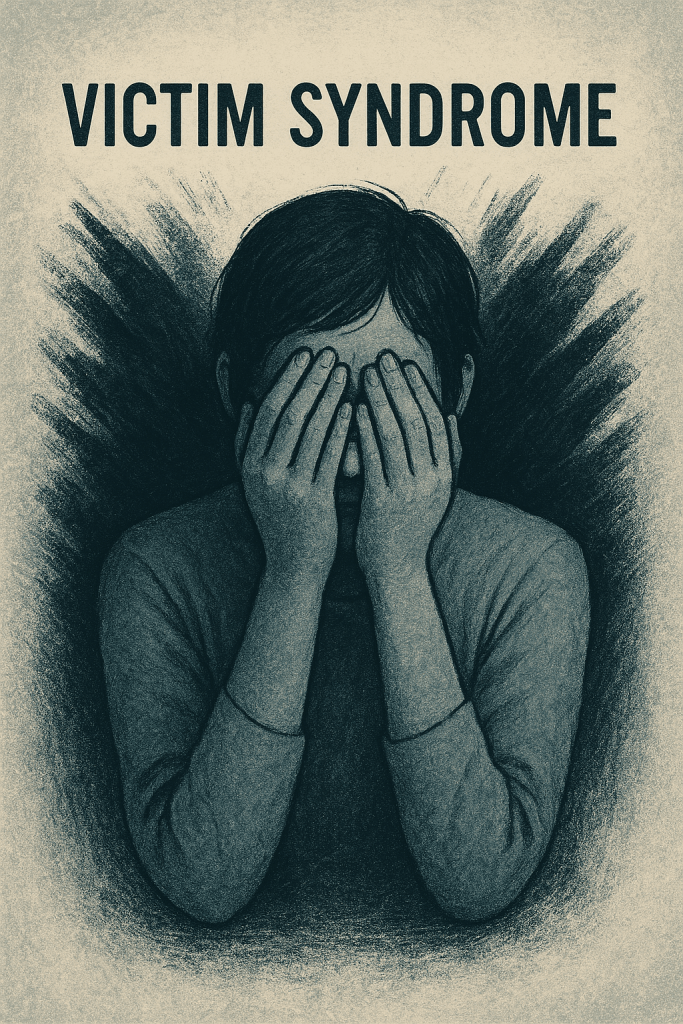
Victim Syndrome: The Silent Trap
Piotr and Paula grew up in the same household, yet their fates could not have been more different. While Piotr’s struggles were loud—anger, self-destruction, and failed attempts to prove himself—Paula’s suffering was quiet, almost invisible. Their roles were set early: Piotr was the problem, Paula was the solution.
This pattern is a textbook example of victim syndrome, a psychological state where a person sees themselves as trapped by circumstances beyond their control. But victimhood does not always look the same—it wears different masks depending on gender and social expectations.
For men like Piotr, it often manifests as externalized suffering: anger, self-sabotage, addiction, or aggression. Society teaches them that expressing vulnerability is shameful, so they lash out instead. Piotr carried his burdens through silent rage, resorting to casual encounters and reckless decisions to avoid confronting his pain.
For women like Paula, victimhood is internalized. She learned early that her worth came from obedience, from not causing trouble. She excelled in school, pleased her parents, and played the role of the perfect daughter—until she was married off and trapped in a life where her silence was mistaken for contentment. She carried generations of unspoken trauma, reinforced by a mother who had taught her to be grateful, to endure, to never ask for more.
Psychologists refer to this phenomenon as learned helplessness—a term coined by Martin Seligman in the 1970s. When people experience repeated situations where they have no control, they stop fighting back, even when escape becomes possible. Paula accepted her fate not because she was weak, but because she was conditioned to believe there was no other way.
Piotr, on the other hand, was forced into change. His spiral led him to Israel, where he saw a different way of living—a culture that, for all its flaws, taught him that men could cry, could heal, could rebuild. He found a woman who refused to tolerate his self-destruction, forcing him to confront his depression and seek therapy.
Paula stayed behind, holding onto a family that demanded everything from her while giving nothing in return.
But one day, something cracked.
For five years, Paula carried the weight of her family alone. With Piotr gone—disappearing to Israel, only sending the occasional polite message—she had no choice but to step into the expected role. She married Marek, a practical choice rather than a romantic one, and devoted herself to being the perfect wife and mother. She dressed as she should—feminine, modest, always careful not to draw the wrong kind of attention. Gym clothes, jeans, even leggings felt foreign to her; she wouldn’t dare.
Yet, something gnawed at her. Despite doing everything right, she felt distant from her own son. The love was supposed to come naturally, wasn’t it? Instead, she felt detached, performing the motions of motherhood rather than feeling them. It left her hollow, guilty. But she didn’t question it—she had no time. Between caring for her father, whose health had declined, and making sure Marek never had to lift a finger at home, there was no room for doubt, only duty.
Then, the call came. Their father was dead.
And with that, Piotr returned. Not just Piotr—the lost brother who had once shared her burdens—but a version of him she no longer recognized. He came back with Limor, his Israeli wife, a woman so unlike anyone Paula had ever met. Strong, confident, unapologetic. And most shockingly—respected by Piotr.
At the funeral, Paula barely spoke to her brother. But she watched. Watched how he carried himself, how he treated his wife as an equal. Watched how Limor, heavily pregnant, didn’t hesitate to speak her mind, even in a language she barely understood. Watched how Piotr listened to her.
Something about it unsettled her.
And then, over dinner, the first crack appeared.
Marek (casually): “The food was good tonight. But I think Limor’s cooking was better.”
Paula tensed, expecting Limor to laugh it off. Instead, she simply shrugged.
Limor: “Oh, I don’t cook. Piotr does.”
Marek blinked, thrown off. “What?”
Piotr, who had been quiet until now, set down his glass. “Marek, that’s a little sexist, don’t you think?
Marek frowned, clearly confused. “What? I didn’t say anything wrong.”
Paula’s instinct was to smooth things over, to make sure no one got offended. But she hesitated.
For the first time, she wasn’t sure if she should.
After the dinner confrontation, Paula couldn’t shake the unease that settled in her chest. The sight of Piotr cooking for Limor, their equal partnership, contrasted starkly with her own life. She had always believed that her role was to serve, to meet expectations without complaint. Yet, here was her brother, defying those norms.
One afternoon, as they cleared the remnants of lunch, Paula found herself alone with Piotr. The air was thick with unspoken words.
Paula: “You’ve changed, Piotr. Israel has made you different.”
Piotr: “I had to change. For myself, for Limor. Staying the same wasn’t an option.”
Paula hesitated, the weight of years pressing down on her. “But isn’t it too late for that? I’m nearly 40. This is the life I’ve built.”
Piotr: “It’s never too late, Paula. Studies have shown that many people successfully change careers and find greater happiness even after 40. “
She looked away, memories of sleepless nights and unfulfilled days surfacing. “I wouldn’t even know where to start.”
Piotr: “Recognizing the need for change is the first step. Many feel trapped by societal expectations, especially women. Research indicates that women often face intense pressure to perform in familial roles, leading to higher instances of internalized stress and disorders like PTSD. “
Paula sighed, the weight of his words sinking in. “But how did you do it? How did you break free?”
Piotr: “I realized that change was my choice. No one else could make it for me. And age? It’s just a number. Our 40s can be a pivotal time for transformation. In fact, many experience significant life shifts during this period. “
Paula nodded slowly, a spark of hope igniting within her. Perhaps, just perhaps, change was within her grasp too.
Piotr: “It’s about taking that first step, Paula. Recognizing that you have the power to redefine your life, regardless of age or past decisions.”
As the afternoon sun cast long shadows across the room, Paula felt the stirrings of a new path unfolding before her.
Paula hesitated before leaving the house. She had told Marek she was going for a “girls’ day”—a nails appointment, some spa time, and coffee with her best friend, Magda. It wasn’t entirely a lie. She had called Magda the night before, asking her to cover for her in case Marek asked.
“Why are you sneaking around like you’re having an affair?” Magda had laughed.
“Because if I told him I was going to therapy, he’d never let me hear the end of it,” Paula had muttered. “He thinks therapy is for lunatics, not normal people with ‘real problems.’”
Magda had sighed. “Fine, I’ll be your alibi. But you owe me actual coffee next time.”
Now, standing outside the quiet office, Paula hesitated. The shame felt suffocating. In Poland, people didn’t just go to therapy. Therapy was for the weak, for those who couldn’t handle life. She had spent years performing the role of a perfect wife, hiding every doubt and resentment under layers of lipstick and polite smiles.
But now, here she was, about to sit in a stranger’s office and admit—what, exactly? That she was unhappy? That she didn’t even like her husband anymore? That she had no real bond with her son? That watching Piotr and Limor had made her realize how small her life had become?
Taking a deep breath, she pushed open the door.
An hour later, she left the therapist’s office feeling raw. The woman—Tabi—hadn’t told her what to do. She hadn’t given her easy answers. Instead, she had asked one question that had stuck in Paula’s mind:
“What if you stopped trying to be who everyone else wants you to be and started figuring out who you actually are?”
Paula wasn’t sure she had an answer yet. But as she walked to the café where Magda was waiting, she realized something—she didn’t regret coming.
Maybe this was the first real thing she had done for herself in years.
Understanding Victim Syndrome: Prevalence, Susceptibility, and Individual Realities
Victim syndrome, the tendency to see oneself as a perpetual victim of circumstances, manifests differently across individuals. Some people internalize it through guilt and self-blame, while others externalize it by making excuses for their failures. Research shows that:
• Gender Matters: Studies indicate that women may experience victim-related psychological responses more frequently. One study found that female physicians were 2.5 times more likely to experience second victim incidents compared to their male colleagues. (Source)
• Personality Plays a Role: Individuals with high levels of neuroticism are more prone to victim syndrome. This means that if you’re naturally anxious or sensitive, you might be more likely to fall into a victim mindset. (Source)
• It’s Not Always About You: Not everyone who struggles is suffering from victim syndrome. But if you find yourself blaming literally everything—your parents, your ex, the government, your neighbor’s cat—it might be time for some self-reflection.
Before You Cry Oppression, Check Your Grammar
Now, before you start yelling at me in the comments, claiming you’re not a victim, you’re a boss—please, for the love of all things holy, check your grammar first.
And if you’re about to type “Not all men!” or “Women do it too!”—relax. Read the post again. We literally just talked about both men and women, how victim syndrome manifests differently, and how it’s shaped by expectations. If you missed that part, maybe slow down and try reading for comprehension this time.
I mean it. If you’re gonna write an angry comment, at least proofread it. If you’re feeling extra rebellious and want to spray-paint your rage on a wall, make sure you spell my name right. Nothing ruins a revolutionary message faster than a tragic typo.
Call to Action: Because Self-Improvement is Sexy
If you see yourself in Paula or Piotr, or if you recognize their struggles in a friend, don’t be afraid to take action. Therapy isn’t just for “crazy people”—it’s for anyone who wants to understand themselves better. And if you’re not ready for that, at least share this blog post. Who knows? You might just help someone get their life together.
And if you’re still planning to comment “Not all men”… buddy, take a deep breath, go for a walk, and then check your grammar.
Eine Antwort zu „꧁ 𝒞𝑒 𝓃’𝑒𝓈𝓉 𝓅𝒶𝓈 𝓁𝒶 𝒻𝒶𝓊𝓉𝑒 𝒹𝑒𝓈 𝒶𝓊𝓉𝓇𝑒𝓈 𝓈𝒾 𝓃𝑜𝓊𝓈 𝓃𝑜𝓊𝓈 𝓁𝒶𝒾𝓈𝓈𝑜𝓃𝓈 𝓅𝒾𝑒́𝑔𝑒𝓇 𝓅𝒶𝓇 𝓃𝑜𝓈 𝓅𝓇𝑜𝓅𝓇𝑒𝓈 𝒻𝒶𝒾𝒷𝓁𝑒𝓈𝓈𝑒𝓈. ꧂”.
-
Many people say that it is enough to take the „first step“ for changes to occur. Sometimes they come easily, but usually this first step is repeated or starts even lower. It also happens that when you get to the top it turns out that it was better at the bottom. Despite everything, if you feel that changes are needed, you should try and try until you cross the second step and then the next one.


Hinterlasse eine Antwort zu GreyStoryTeller Antwort abbrechen