
Abonnieren, um weiterzulesen
Schließe ein Abonnement ab, um Zugriff auf den Rest dieses Beitrags und weitere exklusive Inhalte für Abonnenten zu erhalten.

dailypost dailyprompt dailyprompt-1868 dailyprompt-1970 dailyprompt-1977 dailyprompt-1980 dailyprompt-1984 dailyprompt-1993 dailyquestion economy feminism feminist frau Frau im internet Frau Mutter Renate germany health her history lets talk lifestyle live style love man men mental-health Men’s behavior my personal story narcissistic relationship prostitution real talk relationships satire selflove sex sex talk sexwork subscribers only Tagebuch Tagebuch online trauma weibliche Gesundheit woman woman-life woman Perspektive women
Herzlich willkommen
Welcome
Ich bin Frau Mutter Renate
Mein Kopf ist ein deutsches Arbeitsamt.
Meine äußere Erscheinung ein französisches Manifest von Simplizität, Bequemlichkeit und Eleganz.
Und meine innere Kritikerin ist ein alter Jude, der eine zweite Synagoge gründet, weil er zur ersten nicht gehen will.
Wie soll man sich fokussieren, wenn Palästina in der Küche steht?
Ganz einfach:
Man schreibt.
Man redet.
Man lacht über den inneren Rabbi, streitet mit dem deutschen Beamten, und lässt den Tee nicht überkochen. No tabu, just real talk. In englisch, German or French because life is to short to speak only in one language ;)
Feel free to comment, like and schare.
Schließe ein Abonnement ab, um Zugriff auf den Rest dieses Beitrags und weitere exklusive Inhalte für Abonnenten zu erhalten.

ENGLISH VERSION ( German below)
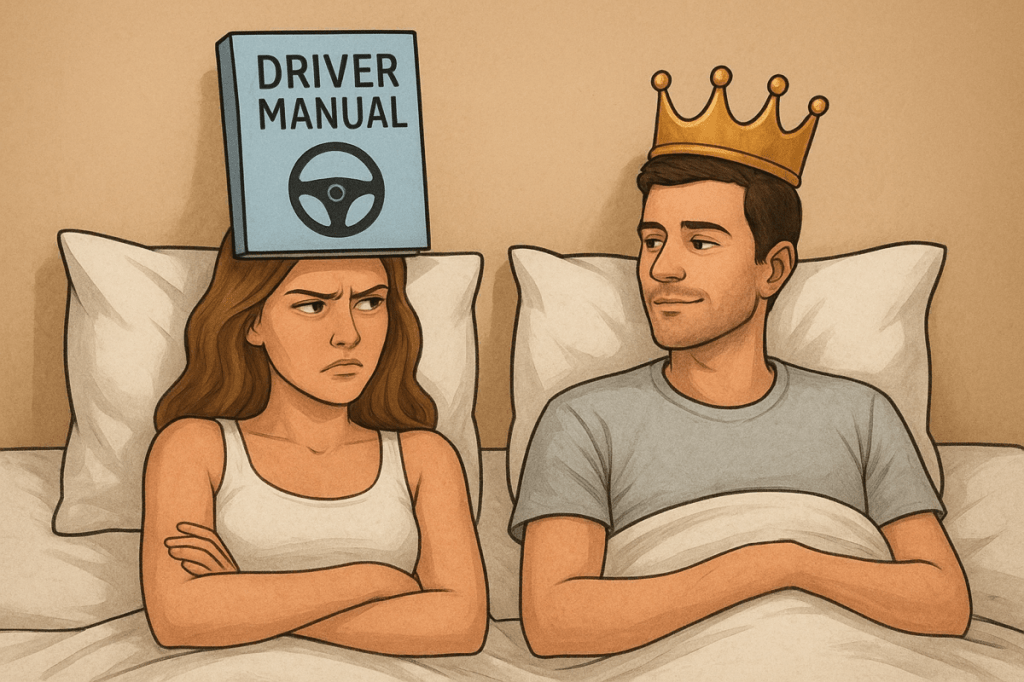
The man on the other side of the bed once said to me,
“You’re the last woman in my life.”
I looked at him and said,
“So you’re planning a very short life, huh?”
He blinked like a malfunctioning robot.
“Uh… what do you mean?”
“Well,” I said, “you wanted me to get my driver’s license, right?
But I’m learning manual, not automatic.
And, you know, one wrong gear—and we both reach eternity faster than planned.”
He didn’t laugh.
Which was fine, because I wasn’t joking.
Later he asked,
“Do you have feelings for me?”
I looked at him again and said,
“Sweetheart, you’re the last man in my life.”
He smiled like a man who just heard wedding bells.
Meanwhile, I was hearing freedom ringing.
See, he thought we were talking about forever.
I was talking about never again.
Let’s be honest—
I haven’t exactly driven seven men insane,
but I’ve always had an eye for limited editions of madness.
So, dear congregation of broken hearts,
I solemnly swear:
Never again shall I commit the sin of romantic repetition.
Other sins, yes.
But this one? Never again.
Later, over coffee, he said,
“I can see you don’t appreciate me.”
I wanted to roll my eyes,
but with a migraine, you don’t roll anything.
Not even your patience.
So I let him speak.
He continued, proudly destroying Polish grammar:
“When I break up with you, you will learn.
You will appreciate me.
Just like my ex.
She said I was boring, too calm.
But boring is a privilege!”
I looked at him and said,
“I’m not your ex. Not yet.
And boring? Au contraire, darling.
You’re more exciting than a circus colliding with a theatre on fire.”
Let’s be clear—
when we leave, it’s not to play hide and seek.
We leave so we don’t have to pretend anymore.
And yet, there it is—
that universal male farewell:
“When you lose me, you’ll realize what you had.”
“You’ll never find anyone like me again.”
To which I always reply,
Please, put that in writing.
So I can sue you later for false advertising.
( DEUTSCH )
Der Mensch auf der anderen Seite des Bettes sagte einst zu mir:
„Du bist die letzte Frau in meinem Leben.“
Ich sah ihn an.
„Also planst du ein sehr kurzes Leben?“
Er blinzelte wie ein alter Fernseher mit Wackelkontakt.
„Wie meinst du das?“
„Na ja“, sagte ich, „du wolltest doch, dass ich den Führerschein mache, richtig?
Aber ich lerne mit Schaltung, nicht Automatik.
Einmal falsch geschaltet – und zack, bist du’s wirklich los, das Leben.“
Er lachte nicht.
Ich auch nicht.
Später fragte er:
„Hast du Gefühle für mich?“
Ich sah ihn wieder an.
„Schätzchen, du bist der letzte Mann in meinem Leben.“
Er strahlte.
Ich schwieg – aus Selbstschutz.
Er dachte an Hochzeit.
Ich dachte an Lebensversicherung.
Seien wir ehrlich:
Ich habe nicht sieben Männer in den Wahnsinn getrieben,
aber ich habe ein Talent für limitierte Ausgaben von Wahnsinn.
Also, liebe Gemeinde der Überlebenden,
ich schwöre feierlich:
Nie wieder werde ich die Sünde begehen, mich zu verlieben.
Andere Sünden – bitte, ja.
Aber diese? Nie wieder.
Später, bei Kaffee, sagte er:
„Ich sehe schon, du weißt mich gar nicht zu schätzen.“
Ich wollte die Augen verdrehen,
aber mit Migräne dreht man nichts – nicht mal den Kopf.
Er fuhr fort, mit Polnisch, das jedem Grammatikbuch Schmerzen zufügte:
„Wenn ich Schluss mache mit dir, wirst du lernen.
So wie meine Ex.
Sie sagte, ich sei langweilig.
Aber langweilig ist ein Privileg!“
Ich sah ihn an.
„Ich bin nicht deine Ex. Noch nicht.
Und langweilig? Au contraire, mein Lieber.
Du bist Zirkus und Theater in einem – brennend, laut, unausstehlich.“
Lassen wir die Wahrheit stehen:
Wenn wir gehen, dann nicht, um vermisst zu werden.
Wir gehen, um endlich durchzuatmen.
Und dann kommt er,
der ewige Abschiedssatz der Spezies Mann:
„Wenn du mich verlierst, wirst du erst merken, was du hattest.“
„Du findest nie wieder jemanden wie mich.“
Und jedes Mal denke ich:
Bitte schriftlich.
Damit ich dich verklagen kann – wegen irreführender Werbung.
„𝒲𝑒 𝓈𝓊𝒻𝒻𝑒𝓇 𝓂𝑜𝓇𝑒 𝑜𝒻𝓉𝑒𝓃 𝒾𝓃 𝒾𝓂𝒶𝑔𝒾𝓃𝒶𝓉𝒾𝑜𝓃 𝓉𝒽𝒶𝓃 𝒾𝓃 𝓇𝑒𝒶𝓁𝒾𝓉𝓎.“
𝐹𝓇𝒶𝓃𝒸̧𝑜𝒾𝓈 𝒹𝑒 𝐿𝒶 𝑅𝑜𝒸𝒽𝑒𝒻𝑜𝓊𝒸𝒶𝓊𝓁𝒹
Complaint to the Man Who Called Himself Human
I can no longer cry.
The tears have frozen.
In my eyes now lives only ice.
My voice, once strong, is lost and quiet.
Silenced within a circle of silence.
Your words cut through my ears like knives,
draining me of fear where love once resided.
I look at you, yet I am afraid.
Your gaze brings only judgement and danger.
In the mirror, I barely recognize myself.
The girl I once was — buried, banished.
The woman who came after never found her happiness,
because no one saw her, no one understood.
I once had a voice —
as bold as the land,
as strong as the earth,
endless, raw.
But you smothered it with a cold hand.
You showed me how silence is enforced.
You gave me a book, full of words of love.
Yet I found no truth within.
Only performance. Only masks.
Never genuine desire.
Even when I shone, you were never on track.
You call yourself human, so full of feeling?
I saw only cold decay.
If this is humanity, this noble goal,
then mercy should turn away from such a name.
I wrote that poem months ago — before I decided to change everything.
But have I really changed?
I gave up my flat.
Moved in with a man who, as you all know, was supposed to be the stable one. The protector. The solid pillar.
And yet now, I can still hear the echo of my own voice — that very first evening together — asking a question I thought was only half a joke:
“𝓘 𝔀𝓸𝓷𝓭𝓮𝓻 𝓱𝓸𝔀 𝔂𝓸𝓾’𝓵𝓵 𝓫𝓻𝓮𝓪𝓴 𝓶𝓮.”
Maybe I wasn’t asking. Maybe I was prophesying my own downfall.
Because now, after barely two months of living together, I know exactly how he breaks me. Not with fists. But with constant shouting. With accusations born from insecurity.
With hearing only the parts that justify his own rage. Yesterday, for instance. I felt terrible after the gym, too exhausted to talk. He called immediately. And I, the good girl that I am, picked up — because I knew what would follow if I didn’t.
When the master calls, you answer.
Otherwise, there will be war. He began to talk — endlessly — and interrupted me three times. Twice I dared to say, “Please, let me finish.” The third time, I gave up.
And that, apparently, was my sin.
Because silence — my silence — gave him space to decide that my tone was the reason for his anger. That I had spoken more gently to my ex than to him. And just like that, the trial began. My second mistake that day?
I sent him a link to an online course about communication.
In my naïve mind, it was a peace offering.
In his, an act of war. That evening, we argued for two straight hours.
He shouted.
I tried to breathe.
He said it was my fault he was angry, because I would have preferred the other man. He spat insults about someone who has long ceased to matter.
And when I said, “My head hurts, please stop shouting,” he screamed louder — breaking yet another of his promises not to. So here it is — the truth:
The man I thought was solid is emotionally hollow. A grown man behaving like a toddler. A fifty‑year‑old child desperate to win a war that exists only in his mind. I asked him, “What am I doing wrong, that you still feel so unsafe next to me?”
He said nothing. He spoke of everything but that. And yes, I’ve done everything to make him feel secure:
I don’t greet other men.
I don’t shake hands.
I avoid eye contact.
I make myself small, silent, compliant — and yet it’s never enough.
Until finally, I screamed.
And I hated myself for it.
I wanted to hit myself, just to stop the noise. Because I despise becoming someone who shouts. He called it manipulation. He said if I didn’t speak Polish properly, he’d hang up. Tell me — what’s more manipulative than that? He twists words until I begin to doubt my own sanity. And in that moment, standing there with my own voice trembling against his, I realised — I’m not the one projecting.
I’m the one surviving the projection of a man who mistakes control for love.
𝓣𝓱𝓮 𝓐𝓷𝓪𝓽𝓸𝓶𝔂 𝓸𝓯 𝓪 𝓒𝓸𝓷𝓿𝓮𝓻𝓼𝓪𝓽𝓲𝓸𝓷 𝓣𝓱𝓪𝓽 𝓘𝓼𝓷’𝓽 𝓞𝓷𝓮
He interrupted me again.
Right when we were talking about interruptions.
There’s a certain irony in that, isn’t there?
He said, “You’re impossible to please.” Then, before I could even respond, he added, “I have a question.”
That’s his usual defence line. Whenever he has no answer, no argument left, he throws in that phrase — “I have a question” — like a smoke bomb.
It’s not curiosity. It’s a tactic.
He needs the pause to rebuild his logic, to find a new angle from which to strike.
And his question? The same as always: “What do you criticise most about me?”
So I answered. Honestly. Calmly.
First — his car.
A Mercedes. Automatic. A symbol of everything he believes defines success. I am no Mercedes‑girl. These cars are for men who want to be seen, not for those who actually go somewhere. I told him once — “I told to you”, he said, mixing Polish grammar into English, “mówię dla ciebie”. You can’t say that. Not in any language. It means nothing. Like so much of what he says.
Second — his figure.

The famous Popeye shape: wide shoulders, no arse. A walking triangle. You know, the cartoon sailor who ate spinach, smoked a pipe, and solved everything with a punch? That one. That’s what he’s built himself into. A man so obsessed with the upper body that he forgot there’s supposed to be a base.
Third — his diet.
He calls it healthy living. Boiled meat with garlic and parsley. Every day. The menu changes slightly, sometimes an egg, sometimes not, but always a mountain of supplements. Capsules instead of flavour. Chemistry instead of nourishment.
Fourth — his language.
He interrupts constantly.
He says he doesn’t hear me because I speak too softly, and when I remind him he cut me off five times already, he insists it’s because he thought I’d finished.
He even admitted once that he sometimes imagines what I might say — he fills in the blanks himself, then later accuses me of saying it.
He literally builds his own evidence.
Fifth — his style.
Philipp Plein. Glitter. Skulls. Over fifty.
He calls it style. I call it a midlife crisis wrapped in rhinestones.
A man preparing to open a business should know the difference between statement and screaming.
And after I listed those things, he said, “You don’t listen to me. You’re always doing something else when I speak.”
He said that yesterday morning — the same morning I was lying on the couch, holding a hot water bottle against my abdomen, barely able to move after the gym, doped on painkillers.
But of course, his voice had to rule the room.
The world pauses so he can talk.
There’s no real conversation between us.
There’s only interruption management.
And sometimes I wonder if this is what love becomes when one person turns dialogue into dominance —
a constant loop of “I have a question”,
when the only question left is:
Why am I still answering?
𝓒𝓸𝓶𝓶𝓾𝓷𝓲𝓬𝓪𝓽𝓲𝓸𝓷, 𝓸𝓻 𝓽𝓱𝓮 𝓛𝓪𝓬𝓴 𝓣𝓱𝓮𝓻𝓮𝓸𝓯
I thought I was a quarrelsome woman, always criticising, always pointing out flaws. But yesterday, I discovered something else—something I hadn’t realised until now: I falsely accused him, too. I accused him of ruining my life, of making me live in constant fear. He cannot imagine being with someone who is afraid of him. And yet, in truth, it is not him I fear—it is his eruptions, his bursts of anger, his relentless insistence on control. I tried to explain this. I told him I was exhausted from always having to make his life the centre of mine. He claimed this was not true. So I asked him, plainly, when was the last time, in three weeks, I had a day to focus on my work, to write my blog, to pursue my goals? Let’s take last week, as an example. I wanted to watch a YouTube video by my favourite vlogger. Five days later, I finally managed to finish it. Just twenty minutes long. And yet—he missed it. Despite me telling him multiple times, in Polish, I wanted to watch it until the end, he ignored me. His solution? “Put on headphones,” he said. As if I had not already done so. Did he notice? Of course not. He kept talking, oblivious to my attempts to disengage, until I gave in and listened. His reality was always more important than mine. Last week, I had planned to study daily, to advance my nutrition training. How much time did I get? Five minutes? Two? None. Exactly zero minutes without him placing himself at the centre of my day, needing to talk, needing attention. He claimed his “freedom” had been taken from him and finally rejoiced that he could speak freely, without criticism. And there I was again, the critic. Instead of learning, I had to sit, endure, and listen to his endless monologues. I tried to explain. He said he would never speak to me again. And honestly? If I were truly honest, I would have said, thank God. May Allah support you in your stubbornness. But instead, I said I did not expect silence from him. I expected understanding. I expected that he would listen when I said I needed a moment for myself. But he never listens. The argument continued, as he constructed, brick by brick, the narrative of why he was angry, why my “failure” had triggered his outburst. And here, my friends, let’s speak plainly: you cannot win against a man who has a problem with communication. Research confirms this. Men and women often communicate differently, especially in conflict. Men tend to take a problem-solving approach, instrumental and task-focused, while women lean toward relational communication, seeking connection and emotional understanding. Misunderstandings are inevitable when each interprets the other’s intentions through their own lens. Furthermore, studies show men interrupt women more often than they interrupt other men. This constant interruption fosters a feeling of being unheard, dismissed, invisible. And there is the emotional toll—men often struggle to express vulnerability and may avoid difficult conversations entirely. This avoidance exacerbates isolation, frustration, and resentment in their partners. Reflecting on this, I see my partner’s communication style mirrored perfectly in these patterns. The more I tried to explain, the more he ignored, interrupted, and controlled. The more I tried to assert my own time, my own focus, the more he claimed freedom to dominate the space I needed. And all the while, I am left exhausted, frustrated, and unheard.
Communication, it seems, is not a shared act with him. It is a battlefield where one voice is allowed—the loudest, most controlling, most self-assured. And if you dare to speak in your own tone, in your own time, you risk being accused of provocation, of criticism, of undermining him. This is what it means to navigate life beside someone who cannot communicate: constant vigilance, constant self-censorship, constant fear—not of him, but of the storm he unleashes. And yet, I endure, I document, I reflect. For if I do not, who will remember that I spoke, that I resisted, that I existed at all?
I wanted him to learn two things from our conversation. First, if he is unsure about what I mean, he should ask. If he thinks he knows something but isn’t certain, he should ask. Instead, what happened? It became my fault again. At 17:20, he messaged me asking if everything was okay, while I was in the middle of a conversation with my best friend. Around 17:30, he sent a second message. By 17:40, a third message arrived—full-on attack. It basically said: “If you don’t care about me, just say so. I don’t care about you.”
And here comes the age-difference issue. For me, a Millennial woman, someone writing with exclamation marks feels like shouting. For him, it’s just emphasis—an assertion of the importance of his words. The problem is clear when you read it like this:
“Jeśli masz mnie gdzieś to napisz! Mam Cię gdzieś! I będę wiedział że wszystko jest OK z Tobą, tylko nie chcesz bym ja się odzywał!”
In other words: “If you don’t care about me, write it! I don’t care about you! Then I’ll know everything’s fine with you, you just don’t want me to contact you!”
This is not about aggression or concern for my well-being. Instead, he called my generation psychologically disturbed and sick, insisting he wants nothing to do with my generation.
𝓦𝓱𝓮𝓷 𝓗𝓮 𝓝𝓮𝓮𝓭𝓮𝓭 𝓪 𝓑𝓪𝓽𝓽𝓵𝓮 𝓜𝓸𝓻𝓮 𝓣𝓱𝓪𝓷 𝓤𝓷𝓭𝓮𝓻𝓼𝓽𝓪𝓷𝓭𝓲𝓷𝓰
For nearly two hours, I tried to calm him down. I absorbed the storm, took the blame, softened my tone — anything to pull him away from that edge of rage. And just when I thought he was settling, when I dared to believe that the shouting might stop, a fresh wave of fury rose from nowhere. Suddenly, it was my fault again — apparently because I expect him to ask when he doesn’t understand something, but when he does, I respond like an “adult,” which, according to him, is an act of arrogance. From there, it spiralled. He accused me once more of not loving him. His reasoning? If he ever failed to reply to my messages immediately, I would supposedly panic, assume the worst, and start a fight. I told him, calmly, that wasn’t true. Unless he were a woman, ill, travelling late at night, or entering a danger zone — I wouldn’t worry. I’d simply assume he was busy, working, on a train with no signal, or just didn’t have the time. I would wait. I would give space. But he refused to hear that. Instead, he snapped, “Right, you don’t love me then.”
Let’s recap, shall we? I am, according to him: argumentative, cynical, impossible to please, emotionally cold, and now — incapable of love. At this point, my readers already know my stance on phone addiction. I genuinely believe no one should live handcuffed to their phone, chained by the illusion of constant availability. This 24/7 expectation to respond — instantly, obediently, emotionally — is madness. I’ve noticed my own tendency to scroll too long, especially on Instagram, and I’m consciously trying to distance myself from it. I take days without touching my phone, go for walks, breathe real air. I value quality time with people, not pixels. But in his world, that’s betrayal. I apologised — again — because it was the only way to stop him from spiralling further. I apologised, even though I’d done nothing wrong. I apologised, the same way I did with my mother, with my rapist, and now with him — taking the guilt that isn’t mine, just to earn a few hours of peace. When I finally hung up, drained and trembling, he began calling again. Four times in a row. Then came the messages, the screenshots, the provocations. I was lying in bed, freezing, with my head pounding and my body shaking uncontrollably, and all I wanted was silence. But he couldn’t stop. He never can. Because the moment I reclaim my quiet, he loses his grip. And so, once again, I became the villain — not because I did something wrong, but because I refused to play the part he wrote for me.
And there it was again — a message from him, after he had gone to the urgent care. Nothing serious, really. But naturally, I found myself apologising. Automatically. As if taking responsibility could somehow shield me from the chaos of his moods. I ask myself now, why did I even say anything at all? Why does he believe he can claim a human being as his property, demanding I show no fear while he explodes? And yet there I am, expected to face the morning with a calm smile while he erupts — because apparently, my reaction to his outbursts is the only thing that counts.
It’s absurd. It’s exhausting. And yet, in that madness, I can’t help but see the echoes of the poem I wrote months ago: the frozen tears, the muted voice, the girl inside me buried under expectation and fear. Today, the poem lives not on paper but in reality, in the space where I am supposed to negotiate my own existence around his volatility.
So I leave it with this: even when the storm passes, when the apologies are given and taken, when I have bent myself into shapes that should make him comfortable, the truth remains. Fear, silence, and self-blame do not make a relationship. And maybe, just maybe, recognising this is the first act of reclaiming my voice.
So now I turn to you, dear reader: if you were in my shoes, how would you act? Would you absorb the blame, swallow the accusations, nod silently while being screamed at? Or would you finally draw a line, say, “No, I will not apologise for your rage, I will not take responsibility for your chaos”?
Think about it — would you let someone dictate your fear and your voice, while expecting gratitude for your existence? Or would you reclaim your space, your mind, and your calm?
Write in the comments. Tell me — would you stay silent, or would you finally let yourself be heard?
Read more -> 1. Psychology Today – Age Gaps in Relationships: What Men and Women Prefer
Dieser Artikel untersucht, wie Altersunterschiede die Präferenzen in Beziehungen beeinflussen und welche Auswirkungen sie auf die Partnerwahl haben. https://www.psychologytoday.com/us/blog/the-asymmetric-brain/202501/age-gaps-in-relationships-what-do-men-and-women-prefer?
2. PsychCentral – All About Age Differences in Relationships
Hier werden die Herausforderungen und Dynamiken von Beziehungen mit großem Altersunterschied beleuchtet, einschließlich emotionaler Reife und Lebensprioritäten. https://psychcentral.com/relationships/age-difference-in-relationships?
3 Medium – The Dark Side of Communication Amongst Age-Difference Couples
Dieser Artikel beleuchtet, wie romantische Ideale toxische Kommunikation und Machtungleichgewichte in Beziehungen mit Altersunterschied verschleiern können. https://medium.com/%40eleos0002/the-dark-side-of-communication-amongst-age-difference-couples-f930de54ca6a?
Schließe ein Abonnement ab, um Zugriff auf den Rest dieses Beitrags und weitere exklusive Inhalte für Abonnenten zu erhalten.
( Two Paths – Dame Drawer )

“𝓐𝓷 𝓲𝓷𝓭𝓲𝓿𝓲𝓭𝓾𝓪𝓵’𝓼 𝓯𝓻𝓮𝓮𝓭𝓸𝓶 𝓲𝓼 𝓸𝓷𝓵𝔂 𝓪𝓼 𝓮𝔁𝓽𝓮𝓷𝓼𝓲𝓿𝓮 𝓪𝓼 𝓽𝓱𝓮 𝓼𝓽𝓻𝓾𝓬𝓽𝓾𝓻𝓮 𝓸𝓯 𝓼𝓸𝓬𝓲𝓮𝓽𝔂 𝓹𝓮𝓻𝓶𝓲𝓽𝓼.”
– 𝓹𝓪𝓻𝓪𝓹𝓱𝓻𝓪𝓼𝓮𝓭 𝓯𝓻𝓸𝓶 𝓖𝓻𝓾𝓷𝓭𝓻𝓲𝓼𝓼𝓮 𝓭𝓮𝓻 𝓚𝓻𝓲𝓽𝓲𝓴 𝓭𝓮𝓻 𝓹𝓸𝓵𝓲𝓽𝓲𝓼𝓬𝓱𝓮𝓷 𝓞̈𝓴𝓸𝓷𝓸𝓶𝓲𝓮, 𝓚𝓪𝓻𝓵 𝓜𝓪𝓻𝔁
A few months ago, we talked about Monique and Aisha — both my friends, both with a past that could break anyone, yet both remarkably different. Monique, theoretically innocent of any criminal record, had worked in escort. Aisha, similarly, but with her own struggles — flirtations with drugs and a slight aggression issue. And yet, we remain friends. Why bring this up? Because they recently dreamed of Turkey. A fresh start. Leave the past behind. But here’s the bitter truth: both are marked — branded by the system. Let’s start with Monique. Years ago, she and a group of about ten German-speaking women — the rest were Hungarian or Romanian and couldn’t participate — were confronted by Kripo officers late at night on Kurfürstenstraße. These officers demanded IDs, pushed women into cars, forcibly searched bags, and photographed documents — all illegal, all humiliating. Monique, fully aware of her rights, refused to show her ID to men who could not prove theirs. She insisted the officers first legitimise themselves, as legally required. They did not appreciate this. She was shoved against a street sign, her bag and documents were forcibly seized and inspected, and her dignity stripped. Seeking help, the group turned first to Olga Café in Berlin, supposedly a sanctuary for women. Reality? Olga flatly refused assistance, claiming legality on her side. Then they went to Neustart, led by Gerd Brummen, who at least attempted to support the women, raising concerns that this behaviour was excessive and illegal. Letters were written, complaints lodged, barricades metaphorically raised — yet the system remained unmoved. Years later, Monique set off to travel. First stop: London, for a vintage conference — her obsession with retro fashion outweighing any caution. The first line she heard at the airport? “Prostitution is not legal in this country.” She barely registered it. She was twenty, young, Polish, and apparently that alone was enough for suspicion. Then, France. Here, she faced absurdity: the officer insisted she needed a visa to move around Europe because she came from Poland. Monique, incredulous, asked Siri, confirmed Poland’s EU and Schengen membership, and pointed it out. The officer, flummoxed, had no words. Miraculously, it was the only polite airport interaction she experienced on her route through Germany and France. Israel was worse. There, an official insisted she was a prostitute, despite her proof of legitimate work at a hotel’s housekeeping service. He refused to believe her, demanding repeated demonstrations and verification, treating her like an object for booking rather than a human being. Monique had no criminal record. Never had. Her only “crime”? Knowing her rights. The repeated humiliation, body checks, and aggressive treatment at borders were her penalty. At one point, when she considered legal counsel, she asked: Do I need a lawyer? Am I under suspicion? That question alone, asked in fear, captures the absurdity of her reality. After Monique, let’s turn to Aisha. She started working on the street at eighteen — escort work, young, vulnerable, yet coming from a relatively good family. At eighteen, she was engaged to a man she loved deeply. The tragedy is, he persuaded her — over weeks, months — to give herself to him while still a virgin. After that, he abruptly ended the engagement, citing her “loss of virginity” as reason, declaring he would never marry her. This left Aisha shattered. Suicide attempts followed, and soon, heroin and other destructive choices became her companions. Her father intervened multiple times, taking her to Turkey for detox clinics, trying to guide her toward a normal life. But the attempts failed. She ran, flew to Morocco with clients, spiralled further, and eventually landed in prison for one or two years. It was after prison that she returned to work on the same street where Monique had been. Their paths crossed in a curious way: a man who had rented Monique a room told Aisha that Monique had stolen her expensive makeup while Aisha stayed there for two weeks. Naturally, he framed it as if Monique had wronged Aisha. What neither of them knew at first was that they would confront him together — and in doing so, they became friends. Both were independent, both unafraid of confrontation, and the man had unwittingly set them up to ally rather than fight. Here is the crucial contrast: family support. Aisha’s family, despite her missteps, had her back. They provided help, resources, intervention, even love when she faltered. Monique, in contrast, navigated life largely alone, without the buffer of familial safety nets. Aisha’s descent into drugs or escort work was not a reflection of being unloved or ignored. It was a combination of naivety, poor decisions, and manipulation by a bad partner — proof that trauma, self-destruction, or marginalisation can strike anyone, even from a “good home.” This is where the system sees no difference. Whether you are alone like Monique or surrounded by family support like Aisha, the mark is still there. The bureaucracy, the stigma, the suspicion — it doesn’t distinguish. It cares only that you existed in a way that challenged or intersected its invisible rules.
Monique and Aisha, though bound by past experiences, could not have been more different in their daily lives. Monique was always punctual — the very definition of it, actually. Aisha, on the other hand, measured punctuality by her own clock: if she turned up that day, she was, in her mind, on time. Over the years, their paths diverged. Aisha remained in Berlin, rooted, continuing friendships with the same women she had known on the street. Monique, restless, kept searching: new jobs, applications, trial days — ever trying to find her footing. Until Corona arrived, shutting down Germany, leaving little to do beyond shopping. During that time, Monique chose a different path: ecology, economics, self-education. She spent more time with Germans, learning, observing, evolving.
Meanwhile, Aisha became pregnant, yet continued on a path most would call reckless for an expectant mother. And still, somehow, her child was born healthy — a testament to her resilience. Monique, in contrast, fell into a toxic relationship. What began well escalated quickly: her partner turned violent. Monique was forced to flee her own apartment, only to find the police refusing to take her report. When she demanded justification, she was told, bluntly: “He is German, you are Polish. If a German beats someone, he will not be imprisoned.” That moment crystallised everything. Monique left Germany.
The contrast between the two women extended to even trivial matters. Aisha mocked Monique’s eco-consciousness, calling her an “Eco-Freak,” while Monique quietly observed how far Aisha had yet to fall. Their clashes became frequent; lifestyle, choices, and circumstances were now poles apart.
Yet their friendship persisted — tenuous, combative, yet somehow enduring. Monique, walking a path of self-education and ecological awareness, and Aisha, navigating the storms of motherhood and streetwise survival, remained tethered by shared history. But history, as always, is a complicated, inconvenient guide.
While Monique faced new challenges back in Poland, Aisha remained in Berlin, navigating the supported housing system that doubted her capacity to be a mother. Monique had bet everything on rebuilding her life, yet even she couldn’t initially trust that Aisha could handle motherhood. Over time, however, Aisha began to change in small, meaningful ways: buying unpackaged goods, choosing organic food for her daughter, and embracing practices Monique had once considered eccentric. Monique started to see that her friend’s choices were not recklessness, but emerging wisdom. At the same time, Monique confronted harsh realities. Two Kripo officers, years earlier, had reacted to her knowledge of her rights with hostility. Her refusal to comply with arbitrary demands had not gone unnoticed; it had left a mark in the system. Though she had committed no crime, the authorities’ notes labelled her as “uncooperative” or “resistant,” effectively marking her as a potential risk. The bureaucratic machinery does not differentiate between actual wrongdoing and the perceived threat of independence.
Monique’s record remained clean on paper, but the invisible consequences were real: at airports, border controls, and security checks, her awareness and assertiveness were treated as hazards. This system, designed to enforce conformity, penalised her self-awareness rather than any illegal act. In contrast, Aisha’s history included documented offences — court records, social service oversight, and medical programs — all explainable and justifiable on paper. Yet both women were treated by institutional mechanisms as unpredictable, potentially dangerous, and therefore flagged in internal codes. It was a cruel symmetry. Monique’s suffering had been compounded by the system itself, not only by the men who had abused her. The stigma she carried was not a reflection of guilt, but of her refusal to remain small, compliant, or invisible. Authority, when challenged by knowledge, reacts with resistance; those who refuse to submit are quietly marked, their independence catalogued as risk. And this is where their stories converge: two women, different backgrounds, different actions, both negotiating the consequences of living beyond the rules imposed upon them. Aisha adapted slowly, learning survival within the system, while Monique fought, questioned, and ultimately left the country to reclaim autonomy — proving that understanding the power of rules does not always guarantee safety, but can guarantee recognition of one’s own strength.
While Aisha settled into her new relationship, letting the world take care of itself, Monique focused on action. She began by reaching out to the relevant authorities, navigating a maze of German bureaucracies from her base in Poland. She contacted the Bundeszentralregister (Federal Central Criminal Register) to request her official criminal record, ensuring it was up-to-date and accurate. Then, she turned to the Staatsanwaltschaft (Public Prosecutor’s Office) to inquire about the deletion of outdated or incorrect entries in police information systems, particularly those that flagged her as “resistant” or “uncooperative” despite her clean record.
Monique meticulously documented every step, noting dates, correspondences, and the officials she spoke to. She explored her legal rights: under German law, she was entitled to challenge information held against her if it was false or irrelevant. Even while living abroad, she could initiate requests for verification and deletion of incorrect entries. The process required patience and persistence, but for Monique, each step was a reclaiming of autonomy — a tangible way to translate knowledge into empowerment.
Meanwhile, Aisha remained focused on daily survival: managing her daughter, negotiating housing, and adapting to the system’s constraints. Both women shared the dream of leaving Europe and starting anew, possibly in Morocco, but only one of them had committed to concrete action to change her circumstances. For readers who may find themselves in similar situations — facing systemic misunderstanding, stigma, or bureaucratic barriers — Monique’s approach offers a practical blueprint:
1. Verify your records – request your official criminal record or equivalent from the relevant authority.
2. Identify flags or entries in police or government information systems.
3. Understand your legal rights to challenge or request deletion of incorrect or outdated information.
4. Document every step – keep correspondence, note dates, names, and reference numbers.
5. Persist – these processes take time, but consistent action can yield tangible results.
And so the question remains, not just for Monique and Aisha, but for anyone reading this:
If you were in their position, facing a system that penalises awareness and rewards compliance, what would you do? Would you act like Monique, mapping out your rights and challenging every unjust encounter? Or would you adapt like Aisha, working within the system and accepting its limits?
Write your answer in the comments — reflect, choose, and share. The system may be rigid, but awareness and action are always yours to claim.
( For those curious about how Monique’s requests are progressing, or if you want practical tips on navigating similar situations, feel free to reach out. You can leave a comment, message me directly, or contact me via Instagram or Facebook. Your questions are welcome — let’s make this a conversation. )

Long, long time… but not that long ago, behind Zakopane, behind Snieszka, but before the Baltic Sea, there lived a curious creature called Woman. A terrible creature, some said. She gave zero fluff about belonging. She chose to belong only to her dog—a Mini Schnauzer, enormous in her mind, but tiny in reality. Yet, as politics would have it, society still called her the owner. Weird, right, my dears? Let’s call her Anna. Anna was paradoxical: she went to Spain to learn German, then to Germany to learn Russian. She wore feminine clothes, but she put herself first, sometimes acting more like a man. She hated yoga but did it anyway; she wasn’t afraid of CrossFit. Sharp-minded, soft-spoken. A walking contradiction, a paradox of freedom. Anna walked through hell made by men. Every man she met took her for granted, never as a human being. So she changed her name. Not on a whim. Not because she wanted to be rebellious. No, she acted in a moment of survival, after what no one should endure. And yes, in Poland—a country devoutly Catholic—she found relief in Islam. Ironic, satirical, absurd? Yes, all of it. She traveled, converted, learned languages, built paradoxes, and kept her dog close. Because a creature that large, that loyal, that judgment-free was the only being who didn’t try to own her. Society blamed her for everything. But Anna shrugged, raised her beautiful middle finger—tattooed, permanent, defiant—and whispered to the world: “I belong to me first.”
The Seven Archetypes of Women Across the World
Now, my dears, let us peek into the global kaleidoscope of female archetypes. In ancient Indian and Buddhist texts, sages carved out seven archetypes of wives:
1. The Destructive – scorns her husband, seeks other men.
2. The Thief – squanders the husband’s wealth.
3. The Tyrant – dominates her husband.
4. The Motherly – nurtures with care.
5. The Sisterly – treats with respect and modesty.
6. The Friendly – companionship over obligation.
7. The Slave-wife – obedient, patient, submissive. (source)
Across Europe, women were boxed as saints, sinners, mothers, or temptresses. Greek goddesses like Hera, Artemis, and Aphrodite showcased power, independence, and desire. In Norse myths, Freyja balanced sensuality and sovereignty. In Africa, Yemoja represents motherhood and nurturing, Oya embodies storm and transformation. Arabic poetry reveres the beloved and the rebel, and in Latin America, La Llorona embodies grief and social judgment.
Everywhere, the pattern repeats: women are categorized to control them, rarely celebrated for self-determination.
The Male Archetypes and the Illusion of Equality
Ah, but if women are boxed, what of men? Jung identifies four mature masculine archetypes:
• King – order, blessing, direction.
• Warrior – courage, discipline, boundary.
• Magician – insight, transformation, knowledge.
• Lover – empathy, connection, passion. (source)
Yet these archetypes, while extolled, are seldom questioned or feared. Men are roles; women are judged. True equality demands the recognition of contradictions, paradoxes, and shadows in both genders. Anna embodies this: a fusion of chaos and control, softness and strength, freedom and survival.
Freud, Jung, and the Psyche of Anna
Anna’s mind is a landscape of paradox: Freud might call her an ego forged in defense, zynicism as shield, independence as survival mechanism. Jung would call her the individuated Self, a delicate balance of anima and animus, shadow and consciousness, feminine and masculine energies. Society, however, labels her rebellious, unapproachable, irritating to men. Zynicism, apparently, disturbs only one social group.
Names, Faith, and the Patriarchal Cage
A woman rarely owns her name. She is first the daughter of her father, then the bride of her husband, her legal and social identity constantly tied to men. In Poland, surnames reflect patriarchal authority: sons inherit, daughters shift their name upon marriage. By choosing her own name, Anna seized sovereignty, rejecting invisibility and male ownership.
Faith too becomes theater: Anna chose Islam, ironically, in a Catholic-dominated country. Her hijab was not submission—it was assertion. And society gasped, as they always do when a woman refuses to belong to the expected boxes.
Clothing, Morality, and the Moral Police
Ah, the debates rage: what a woman wears, how she behaves, who she is allowed to be. In Poland, young men often act as enforcers, commenting, policing, shaming women for moral “incorrectness,” much like in Germany’s ongoing hijab debates. The control is subtle, social, and relentless. And yet, Anna laughs. She walks, she defies, she exists.
Conclusion: The Middle Finger of Freedom
Anna’s story is every woman’s story who refuses the boxes. Who rejects names, roles, and ownership that are not hers. Equality is only real when women and men can embrace paradox, contradiction, shadow, and light. The world may name you, judge you, police you—but belonging begins when you say:
“I belong to me first.”
If you want to read more…
• Sujata and Seven Types of Wives — https://en.wikipedia.org/wiki/Sujata_and_seven_types_of_wives
• Life of Buddha: Sujata & Seven Types of Wives (Part 2) — https://www.buddhanet.net/e-learning/buddhism/lifebuddha/2_11lbud/
• The Four Archetypes of the Mature Masculine: Introduction — https://www.artofmanliness.com/character/behavior/king-warrior-magician-lover-introduction
• The Four Archetypes of the Mature Masculine: The King — https://www.artofmanliness.com/character/behavior/the-four-archetypes-of-the-mature-masculine-the-king/
• The Four Archetypes of the Mature Masculine: The Lover — https://www.artofmanliness.com/character/behavior/the-four-archetypes-of-the-mature-masculine-the-lover/
• King, Warrior, Magician, Lover — Rediscovering the Archetypes of the Mature Masculine — https://www.amazon.com/King-Warrior-Magician-Lover-Rediscovering/dp/0062506064

I can’t say many positive things about my mother, but I do remember a few. She loved books and was really good at reading—better than I ever will be. When she was relaxed, she was careful with her words. Sometimes, even, she could be loving. But most of the time, she was a monster to me. And honestly, she couldn’t help it. She never had a proper home. She struggled with her adoptive parents as a teenager, was almost given up by them—just like her biological mother had given her up. She never learned how to love, so she couldn’t teach me.
But I learned.
The first mother I truly desired was Maria. I wasn’t Catholic at heart, but her story fascinated me. The second was my aunt, Dr. Johanna. She was perfection in every way—disciplined, elegant, her apartment immaculate, utterly stable. For years, I wished she could be my mother. And the third was my neighbour in Germany, the most loving woman I have ever met. She was lonely, I had no mother, and somehow we fit. Perfect match. I realise now that I searched for women with curly hair. I believed, for a long time, that straight hair meant aggression, or at least a higher potential for it, compared to curly hair. It sounds ridiculous, right? But somehow, my self-image practised that distinction. And every single woman with curly hair seemed warmer, softer, more loving than my mother ever was. The first hug I ever received was from a man in Germany, when I was nineteen. My first taste of milk products, like yogurt, came from my aunt at the age of ten. The first time someone called me by my real name was in kindergarten, at five years old. So, as you can see, living with your mother can be… complicated. But we love talking about daddy issues, don’t we? It sounds nice, melodic even. But what if we flip the script and look at mothers? Because believe it or not, there’s something called mommy issues too. And when I started reading about them, I was shocked—how many people struggle with them, and why? Let’s explore that.
What Are “Mummy Issues”?
“Mummy issues” aren’t just a clinical term—they’re a lived experience, a shadow that follows you into adulthood. They arise from the emotional and psychological gaps left by a mother who couldn’t, or wouldn’t, give what was needed. These gaps can take many shapes:
• Attachment Disorders: The inability to form healthy emotional bonds, often because maternal care was inconsistent, neglectful, or outright absent.
• Low Self-Esteem: Feeling never quite enough, internalising messages of inadequacy when a mother was critical or emotionally unavailable.
• Relationship Difficulties: Trust issues, fear of intimacy, constant searching for reassurance—all patterns learned before you even knew the world existed outside your mother’s eyes.
• Emotional Dysregulation: Struggling to manage emotions, swinging between anger, sadness, and anxiety, often without a blueprint for balance.
For me, this became real when I recognised it in my partner. A man in his fifties, yet expecting from me the kind of emotional care that should have come from his mother—care, validation, praise, stability. When I saw him lash out in frustration, demanding regulation and comfort, I understood: this was not just personality. It was the echo of years of maternal absence, of repeated hurt. His mother never offered compliments. She regularly reminded him he “should never have been born.” Those messages, those omissions, shaped a life where aggression became a tool of control, where emotional regulation remained foreign, and where risk and conflict were often met with force rather than reason.
The Gendered Impact of Maternal Attachment
Attachment theory, pioneered by John Bowlby, shows how early bonds—or the lack thereof—with caregivers shape our emotional lives. There are often gendered patterns:
• Men tend to develop avoidant attachment. They struggle with intimacy, withdraw emotionally, and avoid vulnerability. When their early maternal needs are unmet, this can escalate to narcissistic traits, using power, aggression, or emotional manipulation as a substitute for self-worth. They may demand from partners what was never given to them, expecting others to manage emotions they’ve never learned to handle.
• Women more commonly display anxious attachment, seeking reassurance and fearing abandonment, sometimes overcompensating in relationships to secure love they feel they never received.
For my partner, this dynamic is palpable. His unresolved maternal wounds translate into a lifelong expectation: that I step into the maternal void. And the harder I resist, the more explosive the reaction—because for him, control and aggression have long been the tools for coping with fear and emptiness.
Prevalence and Consequences
Insecure attachment isn’t rare. Studies suggest around 40% of adults carry patterns of ambivalent, avoidant, or disorganised attachment. These unresolved maternal relationships can ripple through life, affecting not just mental health but the very architecture of one’s relationships.
The consequences can be profound:
• Mental Health Disorders: Anxiety, depression, and chronic stress are common.
• Relationship Struggles: Difficulty maintaining healthy intimacy, repetition of destructive patterns, and emotional co-dependence.
• Parenting Challenges: Without intervention, the cycle often repeats with the next generation.
• Narcissistic Traits in Men: Aggression, entitlement, and an expectation that partners or friends must supply the missing maternal validation.
When you witness it in real life—as I do—it becomes impossible to ignore. You see the patterns, the triggers, the repeated lapses, and you understand why boundaries are necessary. You also realise how personal history shapes expectations and reactions, often in ways invisible to the person living them.
https://www.medicalnewstoday.com/articles/mommy-issues
Reflection :
When I reflect on all of this, it becomes painfully clear how much of the past still lives in the present. My partner struggles with self-regulation, with clear communication, and above all with accepting boundaries. Time and again, he pushes me into old patterns, unavoidably creating distance between us—even when I know it is unconscious. The man I once thought would embody stability and dominance, the one whose profession suggested a calm, reliable presence, often reveals himself as a three-year-old in need of protection, whose emotions I am expected to manage. I have been accustomed to raising my mother, to nurturing where care was absent. And though I have strong maternal archetypes and a deeply ingrained desire to nurture, this is part of why I do not want children: I have already, technically, raised a child. The confrontation between my boundary-setting and his childish, frustrated defiance is exhausting, sometimes unbearable. And I cannot yet tell whether the relationship will survive if this pattern continues. He is used to partners who were needy, emotionally unreachable, unfaithful, or pathologically insecure. I am entirely uncharted territory for him, with my expectations that he reflect on himself, attend therapy, respect my boundaries, and—most crucially—speak openly about his feelings.
Perhaps I overwhelm him. And I cannot help but ask: why do we not speak louder about this? Not every woman is made to mother. And yet society seems determined to insist that women must take up that role, simply because they possess a womb. Perhaps, just perhaps, the message should be different: women must learn to love themselves first. Only then can they truly love another.
Schließe ein Abonnement ab, um Zugriff auf den Rest dieses Beitrags und weitere exklusive Inhalte für Abonnenten zu erhalten.
In the strategic game of chess, the Queen is the most powerful piece, capable of moving in multiple directions and controlling vast areas of the board. If a player begins to undermine or oppose their own Queen, the game becomes unbalanced, and victory becomes increasingly unattainable. This metaphor aptly reflects societal structures where the empowerment of women is undermined, particularly through religious and patriarchal frameworks.
Historical Context:
Throughout history, religious institutions have often played a pivotal role in the subjugation of women. In medieval Europe, the witch hunts serve as a stark example. Tens of thousands of women were accused of witchcraft, often based on flimsy evidence or personal vendettas, and executed under the guise of religious righteousness. These events were not merely superstitions but were deeply intertwined with the religious and political dynamics of the time.
In ancient Greece, Aspasia of Miletus, a contemporary of Socrates, was renowned for her intellect and influence. However, her contributions were often overshadowed or dismissed due to her gender, reflecting the societal norms that limited women’s roles in intellectual and public life.
Contemporary Manifestations:
In modern times, the oppression of women continues under the justification of religious doctrines. The Taliban’s regime in Afghanistan has severely restricted women’s rights, including banning them from public spaces and education, under the claim of religious adherence. Such actions exemplify how religious narratives can be manipulated to enforce patriarchal control.
Psychological and Sociological Perspectives:
From a psychological standpoint, the use of religion to justify the oppression of women can be understood through the lens of cognitive dissonance. When individuals or groups hold conflicting beliefs—such as advocating for equality while practicing discrimination—they experience psychological discomfort. To alleviate this, they may rationalize their actions by invoking religious or moral justifications, thereby aligning their behaviours with their beliefs.
Sociologically, the concept of “structural sexism” explains how societal institutions, including religious organizations, perpetuate gender inequalities. Studies have shown that religious teachings and practices often reinforce traditional gender roles, limiting women’s autonomy and opportunities.
Conclusion:
The chess analogy serves as a poignant reminder that a society that undermines the role of women is setting itself up for failure. Just as a chess game cannot be won by opposing one’s own Queen, a society cannot thrive when it suppresses the potential of half its population. Recognizing and rectifying these imbalances is not merely a moral imperative but a strategic necessity for the advancement and prosperity of any society.

I knew it — but I didn’t want to believe.
He believed too — though he never knew in what, or perhaps he simply refused to ask.
I knew there would be miscommunication. I knew he would twist every calm into a theatre of control.
And yet… I didn’t want to see it. Because to see it would mean acknowledging the truth: that he was never truly for me.
Take Thursday. I got frustrated — with my dog, with something trivial — and instantly, he assumed the center of my irritation was him. Me, upset at him. Not at the dog, not at circumstance, not at reality itself. He projected. He always projects. And in that projection, his ego, his assumptions, his religion — all of it — became the lens through which I was measured. Meanwhile, when he makes mistakes, when he acts without awareness, I am expected to tread carefully. To cushion him. To manage his fallout. But when I express frustration about something that is not him, something external, I am suddenly the antagonist. His beliefs, his religion, his identity — all become shields, excuses, instruments of control. And I see, clearly now, that it has nothing to do with the actual issue. This is the paradox I live in: I am patient, careful, measured. I am silent, I am observant, I am aware. And yet the moment I breathe frustration into the air, it becomes mine to defend — as though the world bends around his ego, but never around my truth.
He decided we would sleep apart — claiming he needed rest, that he shouldn’t be ‘bothered’ by anyone’s care, least of all mine.
I thought, ironically, that the principle of a housewife has always been to serve the man, to cook before him, to sustain the household. Yet here we lived more like flatmates, orchestrated by his ego.
I offered, calmly, that he could at least learn to manage his rent — a lesson in responsibility, since our intimacy was now suspended, and investments of care, of time, even of my dog, should be measured.
Then came the dog — or rather, the violation of my plates. Two plates, sacred to me, free of meat, untouched by compromise, marked as my boundary. He fed the dog from them, arguing that I was ‘already so close’ to my pet. And in that act, the altar of my personal order crumbled.
Psychologically, one might say he projected — his ego, unresolved maternal conflicts, a hunger for control — onto me and onto the dog. Jung would call this a shadow play; Freud might suggest transference and displacement. Either way, the result is the same: my patience tested, my boundaries challenged, my reality ignored. The night began as an ache and ended as an exorcism. The migraine came without warning — no aura, no signal, just pain descending like a velvet curtain over my skull. Years had passed since I had felt it this way: nausea twisting the stomach, body folding on itself like a creature in winter, sunglasses at midnight, forehead pressed to the coolness of the tiles for a flicker of relief. In that darkness I was not a woman, not a partner, not even a self — only a pulse of pain trying to survive until dawn.
He, meanwhile, drifted between agitation and performance. He asked once what was wrong. “Migraine,” I whispered. He did not hear. He asked again. This time I only raised my hand, signalling silence. The mattress shifted with his turning, his restlessness shaking the bed, the frame groaning until a leg beneath it shifted. Finally, theatrically, he took the couch — a gesture that was not care but statement. I asked him, quietly, if he was angry. Angry at me, or at the dog. “No, baby. All good. Sleep well,” he replied — soft, almost tender, a lullaby over the crack of ice. But I had learned to cage myself in moments like this. Not to show how bad the pain was. Not to say the words that sounded like “kill me now, I can’t take this,” even if my brain was screaming them. People don’t handle it. They flinch from pain that naked. So I smiled instead, even as I folded inward. He read my smile as mockery, as some kind of humiliation. And because the dog slept peacefully on his blanket, he felt small, diminished.
By morning, the ache had sharpened. I woke weaker than I had gone to sleep. I took the dog out quietly at 6 a.m., trying not to wake him. But he was already up, standing in the kitchen, full of accusation and noise. He began to shout — about Poles and Jews and Muslims, about what “they” would or would not accept, his words tumbling like knotted rope, half-puns and half-insults. The Muslim, the Jew, he screamed, as if identity itself were a weapon. I asked him to be clearer, to tell me what he actually meant. But his words came out like kalamburs — twisting, fragmented, impossible to decode. He claimed I was always “low,” because I smiled when the dog lay in his place. But the truth was simpler, and darker: I smiled because I was in pain too deep to show. I smiled because it was the only mask left between my head and his noise.
Psychologically, moments like this are not random. Research on projection and coercive control (Lundy Bancroft, 2002; Sturge-Apple et al., 2010) shows that partners who feel their power threatened often reassert it by reframing their partner’s illness or behaviour as an insult. The dog, the smile, the necklace — all symbols he could weaponise. Meanwhile, your silence — the very thing you used to protect yourself — became, in his narrative, evidence of disrespect. This is how emotional erosion works: the very strategies of self-preservation are reinterpreted as attack. Dawn broke not as light but as weight. My head still rang from the night, but by then the migraine had fused with something heavier, an undertow of exhaustion and dread. He wanted to talk. He wanted to “clear the air.” What came instead was a litany of grievances.
“You cook for me. I don’t know if I’m allowed in my own kitchen. You do everything, and I don’t know what’s left for me.”
The words were ridiculous, yet they fell with the gravity of accusations. I stood there, mute. Speechless not from guilt but from the sheer absurdity of it. In a sane world a man who comes home to warm food and a clean space would be grateful. In my world that morning, gratitude had turned into resentment, like milk gone sour.
I tried to stop him — “I can’t, I have a migraine, I can’t take this right now” — but the words did not slow him. He kept on, even as my legs buckled and I fell to the cold kitchen floor. The tiles were my only medicine. He followed, barking at me to get up. My mind spun, not with his words but with the practicalities of escape: the unsigned testament for Karol, the plan for the dog, what would happen if I simply couldn’t stand again.
He said he would talk calmly now. Anyone believing that would be naïve. He went on explaining all that I had done wrong — that I had no real migraine, that because of me he was missing things, that I was the problem and the reason everything was “bad.” That he needed the living room cleared because he had been “trying to pack” for weeks, but because of my “issues” and “the dog in the bed” he hadn’t slept. And now everything must be unpacked, sorted, done. Or else.
He even dangled money as ultimatum: “I have twenty thousand zloty. I can give you that if you want to move out. Then you don’t need to pack.” Oh boy, I thought. Truly. Somewhere between accusations he said he was tired of me, that he wouldn’t “fight for me,” that he had had enough. I swallowed two painkillers and whispered a prayer for them to work. I kept myself to the barest minimum, words clipped down to nothing.
Later, when the pain was at its worst, I went to the bedroom floor for cold. My hand reached for the necklace — the one I had worn like a truce. I pressed it into his palm. “Give it,” I said, “to whoever you think deserves it.” He ordered me to take it back, to put it on. I refused. “I’m a Muslim, not a Jew. I won’t wear it again. I don’t want the flag of Israel anymore. Judaism is finished for me.” He broke then — between crying and rage — but I could not break with him. It was too much.
By then I had realised the absurdity of the whole tableau: I was forbidden to cook because cooking made him feel bad, he would not have sex because the dog slept in the bed, and yet all of this was somehow my fault. In his logic it was the highest rationality. In reality it was infantile.
When he declared again he wouldn’t fight for me, I rose — still nauseous, migraine spiking — and looked him straight in the eyes. My face was drawn so tight you could see the muscles clenched beneath the skin. “This conversation is over,” I said. “Think carefully about what you’re saying. You’re about to do something there’s no coming back from.”
He claimed he had thought carefully. “No,” I said, “you haven’t. You’re just pitiful and weak. May the gods have more mercy on you than your own god does.” This is what I say when I want to say “fuck off” but choose not to.
He kept chasing me about unpacking, about leaving, about everything. In the evening he insisted we go shopping. I went — sunglasses on, stomach heaving, head splitting — because the alternative was more noise. Eight hours of unpacking with repeated collapses onto the floor just to avoid his rage. Only to hear, at night, “You did a lot today. I didn’t think it would be so much.”
That sentence shattered me more than the day itself. He cooked meat for the dog — the task he had assigned me — and then used my plate to feed it, as if to show that my closeness to the dog meant I might as well eat from its dish.
Psychologically, this is a textbook cycle of coercion and cognitive dissonance. In research on trauma bonding and intermittent reinforcement (Carnes, 1997; Dutton & Painter, 1993), victims adapt by over-performing, minimising themselves, or masking pain to avert punishment. Meanwhile, the aggressor frames ordinary care as control, projecting his own dependency as her fault. The dog, the necklace, the kitchen — all become symbols, props in a private theatre of dominance.
The morning began before dawn — 4:50 a.m., the faint chime of church bells marking the hour. He was already awake, moving through the flat like a restless shadow, his footsteps silent but deliberate. I remained still, clutching my phone, relieved by the absence of messages. No stress. Only Duolingo blinking back at me. For a fleeting moment, I felt a rare sense of peace.
By 6:30, I returned from walking the dog. The air was crisp, a reminder that I was alive, that the day had not yet begun. I donned my headphones, prepared breakfast, and retrieved my laptop from the living room desk. My intention was clear: to write in my blog without disturbing him. He had expressed a desire to sleep longer, and I had agreed.
Then he appeared behind me. I hadn’t heard him approach. He muttered something, and only then did I realize he was awake.
“May I move to the desk and write my blog? I don’t want to disturb your sleep.”
He responded with a vague nod, neither confirming nor denying permission. I set the laptop down, the keys clicking softly. And that’s when I realized: some people are so utterly useless that it takes real material to write them in blood. Perhaps I was the one on the attack now, but at least my attack was honest.
I asked, plainly:
“What does ‘rest’ mean to you?”
He faltered, circling the question like a wolf unwilling to enter a trap. He could describe what my rest was — according to his mind — but not his own.
I pressed on:
“Where do you see yourself in a quarter?”
He blinked.
“A half-year?”
“No. A quarter is three months. October, November, December. Three months. Where do you see yourself — without me, without the dog?”
He couldn’t answer. He spoke of war. Waiting for war. Waiting to vegetate.
Inside my skull, a small voice whispered: Do I have a tumor, or does he? Because my math isn’t that wrong.
Then I asked:
“In which role do you see me? Because if I may not cook for you, may not do this for you, because you feel ‘restricted’, then what do you actually want?”
He drifted. He loves the idea of being loved. He sabotages the reality. He loves the idea of a relationship, but only if he can be single inside it. It’s like a john going to a prostitute, coming home, and telling his wife:
“But I paid. That’s not cheating.”
We had a deal, once. He would tell me where the blame lay. But he only does it after the injury, after he has proven again that I’m not worthy of his trust. That I’m not “good enough” to be spoken to directly.
And still, I held my ground.
“There are studies behind me, Darek. Science. Not just feelings. When mothers see their own dog and their own child, their brains light up in the same networks — emotion, reward, attachment. Stoeckel et al., 2014. That’s not fiction. That’s biology. If your friend compliments my dog more than you, fine, I’ll tell him to compliment you. So you won’t be jealous the dog gets more than you.”
The room went still. The dog yawned, oblivious, yet somehow the only one of us sane.
And then it hit me — as cold and clean as a blade:
He is in love with the thing he imagined, not with what stands before him. He can focus only on the principle of being adored, not on the act of answering a simple question. He cannot survive the hunger of love because he only wants to feed, never to be fed.But then I pause, and I ask myself — and him, silently: But what does love actually mean? We’ve read it in Corinthians, the First Letter, Chapter 13: love is patient, love is kind. But is it really? In practice? In a flat at 5:30 a.m., with church bells clanging and a dog staring at you like a miniature oracle? And what about other religions, philosophies — what do they say? When does the child, or the dog, become a problem? When does your identity show up to object, conveniently, only when it suits you?
Because suddenly, the religion that was invisible yesterday is screaming today. Aha, it says, I have arrived. As if there’s a switch: Jewish, Muslim, secular — take your pick, just as long as it interferes exactly where it bothers the most.
And I think: maybe love isn’t a switch either. Maybe it’s a stubborn dog, a small human, a responsibility that bites when you least expect it. Perhaps, in a world where someone’s ego and a dog’s loyalty collide, the only sensible response is to take a deep breath, pour a cup of tea, and remember that science — yes, the messy, wonderful neuroscience — is on your side. For parents, whether of humans or canines, those same circuits fire in our brains: attachment, care, protection. We cannot cheat biology; it will insist on recognition, attention, love — even from a miniature four-legged tyrant.
And so I sit, in my British morning, with humor like a teabag steeped too long: knowing that love is hunger, no man survives, and yet still, somewhere in the chaos of identities, religions, and furry dependency, I can ask the real question: what does it mean to truly be fed?
Vintage Feministisch, Von eine Frau für Frauen, weibliche Gesundheit, die Zukunft ist weiblich, women health, mental health, self growing, Woman life style, feminin, koscher , halal

Hinterlasse einen Kommentar