
Abonnieren, um weiterzulesen
Schließe ein Abonnement ab, um Zugriff auf den Rest dieses Beitrags und weitere exklusive Inhalte für Abonnenten zu erhalten.

dailypost dailyprompt dailyprompt-1868 dailyprompt-1970 dailyprompt-1977 dailyprompt-1980 dailyprompt-1984 dailyprompt-1993 dailyquestion economy feminism feminist frau Frau im internet Frau Mutter Renate germany health her history lets talk lifestyle live style love man men mental-health Men’s behavior my personal story narcissistic relationship prostitution real talk relationships satire selflove sex sex talk sexwork subscribers only Tagebuch Tagebuch online trauma weibliche Gesundheit woman woman-life woman Perspektive women
Herzlich willkommen
Welcome
Ich bin Frau Mutter Renate
Mein Kopf ist ein deutsches Arbeitsamt.
Meine äußere Erscheinung ein französisches Manifest von Simplizität, Bequemlichkeit und Eleganz.
Und meine innere Kritikerin ist ein alter Jude, der eine zweite Synagoge gründet, weil er zur ersten nicht gehen will.
Wie soll man sich fokussieren, wenn Palästina in der Küche steht?
Ganz einfach:
Man schreibt.
Man redet.
Man lacht über den inneren Rabbi, streitet mit dem deutschen Beamten, und lässt den Tee nicht überkochen. No tabu, just real talk. In englisch, German or French because life is to short to speak only in one language ;)
Feel free to comment, like and schare.
Schließe ein Abonnement ab, um Zugriff auf den Rest dieses Beitrags und weitere exklusive Inhalte für Abonnenten zu erhalten.
This year is slowly winding down, and wherever you look – whatever platform you open, whichever feed you scroll through – everyone seems to be saying the same thing: thank God it’s almost over.
2025 has been a year that stripped many of us down to the bone. Relationships ended in waves. Stories of break-ups, breakdowns, and quiet personal collapses seemed to drift through every timeline. Women were killed across Europe day after day for the simple fact of being women. Everywhere you turned, there was another tragedy, another obituary, another warning shot from a world that feels increasingly hostile to us. And in the middle of that collective mess, I had my own. This year, I was raped again – by another Polish man. And one month later, barely able to breathe, I walked straight into a relationship with a narcissist. A direct collision. A perfect storm. But I also walked back out. And that counts for something. Now December is standing at the door, and I’ve made a decision: this last month belongs to my health. Because no matter how deep I dug, no matter how far I searched, one thing became painfully clear: there is almost no public conversation about what narcissistic relationships do to the body. We talk endlessly about the psychological damage. About emotional volatility. About self-esteem. About trauma bonding. About the financial drain. About the chaos. But almost no one talks about the physical fallout. A relationship with a narcissist is not only a psychological crisis. It is a full-scale collapse of your ecosystem. Your children feel it. Your pets feel it even the fish that barely registers anything except food. Your home energy shifts, your sleep changes, your immune system crashes, your nervous system burns out. During those weeks, my body started shutting down. Cramps, nausea, constant migraines, waves of shaking. I couldn’t eat. A slice of bread felt like swallowing a brick. I woke up exhausted and went to bed shaking. And he didn’t care. He kept pushing, arguing, escalating, feeding off the stress while my body was slipping into emergency mode. I was genuinely close to writing a will — not out of drama, but out of logistics. Because if something happened to me, I knew exactly what would happen to my dog. My ex would dump her in a shelter without hesitation. And that fear alone kept me awake at night. And while all this was happening, access to medical care slowly disappeared. He refused to use condoms. He refused to let me see a gynaecologist. He ignored every boundary I tried to set. Even when I bought condoms myself, he refused them. He came inside me despite me telling him clearly that I did not want children. And in a country where healthcare is expensive, unreliable, and often inaccessible without private pay, every delay becomes a risk. Every appointment becomes a luxury. Whenever I tried to book a medical visit, he found a way to block it — calling constantly, creating conflicts, manufacturing emergencies, arranging deliveries exactly at the time of my appointments. A single tyre delivery for his Mercedes was enough to trap me at home and cancel my visit.People don’t talk about this. But they should. And that’s where this story begins. Day after day, I ate less. Not because he refused to buy food — on the contrary, he bought plenty — but because every time I ate while he was home, my body reacted like it was under attack. Nausea hit me within minutes. My limbs went weak. I couldn’t stand upright without cramps slicing through my stomach. My migraines became a daily battle I never won. And whenever the pain eased just a little, he expected sex.
If I said no, conflict erupted.
If I hesitated, he pushed.
If I pulled away, he guilted, criticised, or demanded closeness as if my body existed solely to regulate his emotions. It wasn’t intimacy. It was pressure dressed up as affection. A suffocating cycle of touching, grabbing, arguing, and then insisting on tenderness as if nothing had happened — as if my job was to soothe him no matter how destroyed I was. My body couldn’t take it. I reached a point where I didn’t want to go to his place anymore — because what he called “home” felt to me like a pressure chamber. A place where my nervous system stayed braced for whatever came next. And when I finally left, my body collapsed in a different way. The hair loss was immediate and frightening. I don’t have thick hair to begin with, so every strand mattered — and suddenly, whole clumps came out in the shower. I avoided talking about it online because it wasn’t aesthetic. And while the internet believed I was slim by style choice, the truth was simple: my clothes were hanging off me. I had to punch a new hole in my belt because my body was shrinking under the stress. I genuinely thought I was the only one going through that — because no one says it out loud. But when I started searching, digging, and comparing notes with other women, I realised something terrifying: I wasn’t alone at all.
Hair loss.
Rapid weight loss.
Chronic digestive issues.
Migraines.
Nausea.
Shaking.
Immune crashes.
Sleep disruption.
Hormonal chaos.
Physical decline that looked almost clinical.
It was everywhere — hidden in comment sections, in anonymous posts, in whispered exchanges between women trying to make sense of what their bodies had endured. And the science supports it. Research on violent and controlling partners shows a clear pattern: Long-term psychological and sexual coercion produces measurable physiological damage. Chronic stress from partner violence alters the nervous system, disrupts hormonal balance, weakens the immune system, affects digestion, triggers hair loss, intensifies migraines, and creates symptoms that mirror autoimmune flare-ups. The body starts shutting down — quietly, systematically — while the outside world thinks everything is fine. And that is where this conversation needs to go next. What frightened me most was realising that my physical symptoms weren’t random. They weren’t imagined. They weren’t “stress exaggerations,” as some still like to call women’s reactions. They were biological consequences of prolonged coercion — consequences that thousands of women experience but almost no one names. And that silence has a long history. For centuries, when women showed physical symptoms linked to emotional distress, doctors called it hysteria. A diagnosis invented to dismiss us. A label designed to imply our bodies were unreliable narrators and our minds untrustworthy witnesses. And the echo of that word still sits behind how women’s pain is treated today. Modern medicine doesn’t call it hysteria anymore. But the reflex is the same: When a woman collapses under the weight of partner violence, she is often given a psychiatric label before anyone checks what her body has survived. The science is brutally clear. The medical system often isn’t. Controlling and violent partners create a state of chronic physiological threat. Your nervous system stays locked in survival mode. Cortisol spikes become constant. The digestive system slows down. Hormones destabilise. Hair follicles shift into shutdown. The immune system weakens. Your heart rate changes. Sleep becomes fractured. Some women develop symptoms that look like autoimmune disorders. Others develop chronic pelvic pain. Some start fainting. Many lose weight rapidly. These are not metaphors. They’re measurable biological cascades. One study linked long-term partner abuse to persistent “autonomic dysregulation” — meaning the nervous system basically stops returning to baseline. Another showed significantly higher rates of chronic pain, migraines, gastrointestinal illness, fatigue syndromes, and reproductive health issues among women experiencing intimate partner violence. Other research found that constant verbal aggression and sexual coercion trigger inflammation markers similar to those seen in severe illness. And when I compared these findings with what women were whispering online, the match was almost perfect.
The shaking.
The nausea.
The hair loss.
The weight loss.
The inability to eat.
The migraines.
The cramps.
The sense of dying slowly in plain sight.
This is not “stress.”
This is the body being worn down by force.
But here’s the part that hits hardest:
When women finally escape and try to seek medical help, they often collide with another problem — misdiagnosis and disbelief. I learned this the hard way.
Instead of being examined physically, instead of anyone asking about the conditions I had been living in, my first encounter with a psychiatrist ended with a label. A severe diagnosis stamped on my record after a quick assessment, based not on my symptoms but on my family history. My body was screaming from trauma, malnutrition, sleep deprivation, and hormonal chaos — and the system called it a disorder. If a man had walked in with the same symptoms after surviving violence, every specialist would have descended on him.
But when a woman does, she is often told:
“You’re overwhelmed.”
“You’re emotional.”
“You’re unstable.”
Or the modern version of hysteria:
“You’re exaggerating.”
And while doctors debate labels, women’s bodies continue to break down. This is why no woman should rush into psychiatric evaluation immediately after leaving a narcissist or an abusive partner.
Your mind is not the only thing in crisis — your body is, too. And unless a doctor understands the physical consequences of coercion, you are at risk of receiving the wrong diagnosis, the wrong medication, and the wrong narrative about your own health.
Which brings me to the point that almost no one talks about but every survivor needs to hear:
After leaving a controlling partner, your first priority is a full physical evaluation.
Because some partners — especially those who use sexual coercion and reproductive control — sabotage your health intentionally. Whether it’s refusing condoms, preventing medical appointments, blocking contraception, or pushing for pregnancy as a means of control, the result is the same: your body becomes a battleground long before your mind understands what’s happening.
And that is where the next chapter of this article must go — into the concrete medical aftermath of partner control, the reproductive risks, and the steps every woman should take the moment she leaves.
𝕀𝕗 𝕀 ℂ𝕠𝕦𝕝𝕕 𝕊𝕥𝕒𝕣𝕥 𝔸𝕘𝕒𝕚𝕟, 𝕀’𝕕 𝕊𝕥𝕒𝕣𝕥 ℍ𝕖𝕣𝕖
(The Medical Checklist I Wish Someone Had Handed Me Before I Walked into Any Psychiatrist’s Office)
Before I ever let a psychiatrist stamp my identity with a diagnostic label, before a psychologist interpreted my trauma reactions as personality traits, before anyone tried to fit my symptoms into a clinical box — I should have checked my body first.
Not because the mind doesn’t matter.
But because trauma warps the body so aggressively that you end up looking “mentally ill” on paper while your biology is simply screaming for help.
Here is the list I wish someone had forced into my hands on day one.
1. 𝔽𝕦𝕝𝕝 𝔹𝕝𝕠𝕠𝕕 ℙ𝕒𝕟𝕖𝕝
What to check:
• Complete Blood Count (CBC)
• Red/white cells, haemoglobin, platelets
• Inflammation markers
Why:
My unexplained weakness, shaking, constant exhaustion and near-fainting spells weren’t “emotional instability.”
They were the aftermath of chronic cortisol spikes, sleep deprivation, and nutritional collapse.
Any doctor who sees only “stress” without checking these numbers is working blind.
2. 𝔽𝕖𝕣𝕣𝕚𝕥𝕚𝕟, 𝔹𝟙𝟚 & 𝔽𝕠𝕝𝕒𝕥𝕖 𝕃𝕖𝕧𝕖𝕝𝕤
Why:
Rapid weight loss, near-blackouts, nausea after meals, and cognitive fog often mimic anxiety disorders — but are classic signs of deficiencies triggered by prolonged stress, malnutrition and disrupted eating patterns.
A narcissist’s environment starves you emotionally first, physically second.
3. 𝕋𝕙𝕪𝕣𝕠𝕚𝕕 𝔽𝕦𝕟𝕔𝕥𝕚𝕠𝕟 (𝕋𝕊ℍ, 𝕗𝕋𝟛, 𝕗𝕋𝟜)
Why:
Extreme stress derails thyroid regulation.
Hair loss, sudden weight drops, irregular temperature regulation, trembling and mood swings are textbook thyroid symptoms — yet women are routinely diagnosed with “emotional dysregulation” instead.
4. 𝕃𝕚𝕧𝕖𝕣 𝔼𝕟𝕫𝕪𝕞𝕖𝕤 (𝔸𝕃𝕋, 𝔸𝕊𝕋, 𝔾𝔾𝕋)
Why:
The nausea after every meal, the inability to digest, the sharp cramps — these aren’t imaginary.
Your liver and digestive system get hammered under chronic stress.
And if you were chronically under-eating or vomiting from anxiety, your liver pays for it months later.
5. 𝕂𝕚𝕕𝕟𝕖𝕪 𝔽𝕦𝕟𝕔𝕥𝕚𝕠𝕟 (ℂ𝕣𝕖𝕒𝕥𝕚𝕟𝕚𝕟𝕖, 𝕌𝕣𝕖𝕒)
Why:
Constant dehydration from crying, panic, not eating, and adrenaline overload quietly compromises kidney stress markers.
Doctors miss this routinely.
6. ℂ𝕠𝕣𝕥𝕚𝕤𝕠𝕝 𝔻𝕒𝕪 ℂ𝕦𝕣𝕧𝕖
Why:
You need hard data on what narcissistic abuse did to your stress system.
If cortisol is flat, spiking or reversed, you will look like you have a psychiatric disorder — when in reality, your nervous system is simply burned out.
7. ℍ𝕠𝕣𝕞𝕠𝕟𝕖 ℙ𝕒𝕟𝕖𝕝
Why:
Reproductive coercion, forced sex, and chronic fear change your cycle.
Amenorrhea, hormonal shutdown, irregular bleeding — they mimic psychiatric symptoms, but they’re physiological trauma responses.
8. 𝔽𝕦𝕝𝕝 𝔾𝕒𝕤𝕥𝕣𝕠𝕚𝕟𝕥𝕖𝕤𝕥𝕚𝕟𝕒𝕝 ℂ𝕙𝕖𝕔𝕜-𝕌𝕡
Why:
Stress-induced gastritis, ulcers, and reflux present as “anxiety symptoms.”
In reality: your stomach is inflamed.
It’s not a mindset issue — it’s mucosal damage.
9. 𝔼ℂ𝔾 + ℂ𝕒𝕣𝕕𝕚𝕒𝕔 𝕊𝕥𝕣𝕖𝕤𝕤 𝕋𝕖𝕤𝕥
Why:
Chest tightness, palpitations and breathlessness get misdiagnosed as panic attacks in women all the time.
But trauma reshapes the nervous system — and the heart reacts.
Rule out damage before anyone labels you.
10. 𝕍𝕚𝕥𝕒𝕞𝕚𝕟 𝔻
Why:
Low levels mimic depression.
And after months trapped indoors with a controlling partner, you will have low levels.
It’s biology, not madness.
11. 𝔽𝕦𝕝𝕝 𝔾𝕪𝕟𝕒𝕖𝕔𝕠𝕝𝕠𝕘𝕚𝕔𝕒𝕝 ℂ𝕙𝕖𝕔𝕜-𝕌𝕡
Why:
Reproductive coercion, sexual pressure, semen exposure you didn’t consent to, and forced contact do real physiological harm.
You need:
• Ultrasound
• Infection screening
• Cervical health check
• Hormonal evaluation
Not because you’re dramatic — because your body was not respected.
𝕎𝕙𝕪 𝕋𝕙𝕚𝕤 𝕃𝕚𝕤𝕥 𝕄𝕒𝕥𝕥𝕖𝕣𝕤
Because without this data, psychiatrists will label survival responses as disorders.
Because without these checks, women walk out with a misdiagnosis instead of a treatment plan.
Because after narcissistic abuse, the body is the first casualty — and the last thing anyone evaluates.
If I could go back, this is exactly where I would start.
Not with a couch.
Not with a questionnaire.
Not with a diagnosis.
But with blood, organs, hormones and the real, measurable damage that a toxic man left behind.
________________
Read more -> https://sierravistahospital.com/blog/the-negative-effects-of-a-toxic-relationship/
https://www.medreport.foundation/post/for-review-how-toxic-relationships-affect-physical-health
https://www.businessinsider.com/physical-signs-body-bad-toxic-relationship-2019-3
______________________________________________
𝐵𝓊𝓉 𝓉𝒽𝑒𝓎 𝒹𝑒𝓈𝒾𝓇𝑒 𝓉𝒽𝑒 𝒷𝑜𝒹𝓎 𝓉𝒽𝑒𝓎 𝒸𝓁𝒶𝒾𝓂 𝓉𝑜 𝑜𝓌𝓃

I remember once sitting calmly at my desk, trying to watch something, when Tarek called. Anyone who’s had a narcissist knows: if you don’t pick up, it’s a war. Problem? In my case, even if I do pick up, it’s still a war. He told me on the phone that he had spoken with his therapist.
I paused. “You don’t have a therapist,” I said. He insisted: “Yes, yes, the one from my friends’ circle. She’s a therapist.”
Ah, right. And what did she say?
“That you are the problem.” Of course. Nothing new. We’ve heard this before in every anecdote he’s ever shared.
“No, you’re argumentative. You provoke constant conflict.”
I raised an eyebrow. “Ah, right. And how exactly did she figure that out? She’s never met me, never spoken to me, doesn’t know me at all.”
He replied, almost proudly: “I told her everything. She said I must leave you because you are argumentative.”
The only sensible line in that case? “I must leave you.”
I nodded. “Then she’s probably right if she’s a therapist. Because you’re not healthy for me.”
He didn’t catch my joke: “Well, considering what you eat, being around me might not be healthy either.”
He said nothing. After a short pause, I said, “You know what? Let’s just leave it like this.”
“How do you mean?”
“I’ll gladly accept that I’m argumentative. Sure, why not.”
He went silent. I laughed. From that moment on, I made it my rule: whatever he said that was meant to blame me, I’d take it in stride. “Yes, I’m argumentative,” became my mantra. Because in that moment, he ran out of arguments. He’d shot himself in the foot. A month later, two weeks after I blocked him everywhere, I started reading and learning more about narcissism, its consequences, and life with such a person. Then I stumbled upon a video where a woman explained: the real issue is that 80% of young men fundamentally despise women. Sure, they agree that motherhood is important, but at the same time, the majority claim to watch hardcore porn daily, where women are humiliated and abused. The root cause? Not women. Not even men in isolation. It’s male insecurity. It’s the lack of willingness to change. I sent this video to a good friend in Israel, and Motti immediately responded ,. It’s basically because of woman fault” . I slipped back into that confrontation pattern. We spent half a day texting, and he insisted, as always, that women are to blame for how men behave. From my own experience, I know the pattern well: many women over thirty are mentally exhausted. They’ve learned to carry the blame themselves. They stop looking after themselves. This pattern repeats in culture, in books like Ogniem i Mieczem written by Henryk Sienkiewicz in 1884 or Lolita, written by Vladimir Nabokov where girl are made into seducer or provocateur for poor, clueless man.
We see it everywhere in society and even in law. Countries still need legislation to clarify that girls under 18 are children – not marriageable, not sexually autonomous. And yet, even that isn’t enough. What does that tell us about our world?
𝓜𝓮𝓷 𝔀𝓸𝓾𝓵𝓭 𝓻𝓪𝓽𝓱𝓮𝓻 𝓶𝓪𝓻𝓬𝓱 𝓸𝓯𝓯 𝓽𝓸 𝔀𝓪𝓻 𝓽𝓱𝓪𝓷 𝔀𝓸𝓻𝓴 𝓸𝓷 𝓽𝓱𝓮𝓶𝓼𝓮𝓵𝓿𝓮𝓼.
𝓑𝓾𝓽 𝓱𝓮𝔂, 𝓯𝓮𝓮𝓵 𝓯𝓻𝓮𝓮 𝓽𝓸 𝓱𝓸𝓵𝓭 𝓪 𝓭𝓲𝓯𝓯𝓮𝓻𝓮𝓷𝓽 𝓸𝓹𝓲𝓷𝓲𝓸𝓷.
I was a teenage girl singing along to rap and hip‑hop — like many others — believing I owned the lyrics, owned the attitude. Seven years of my life gone before I understood what I was celebrating. If I hadn’t fallen into Berlin’s vintage scene, discovered other voices, I doubt I’d ever grasped what sexism really meant. That’s why books like Men Who Hate Women by Laura Bates (2020) matter so much: they pull back the curtain on everyday misogyny — in jokes, language, social interactions — and show us how even men deemed “good fathers” or “nice guys” still participate in systems that objectify women. The book reveals patterns of entitlement, disrespect, and deep cultural bias. But it’s not just about language. In Invisible Women: Data Bias in a World Designed for Men (Caroline Criado Pérez, 2019), we see a cold, structural reality: medical research, workplace standards, public spaces — all tailored for the “default male.” Female pain ignored, female needs marginalised. That data-backed sexism shapes more than stereotypes — it shapes lives. And then there’s The Female Complaint by Lauren Berlant (2008) — a brilliant cultural diagnosis of how women are constantly cast as emotional collateral. In literature, film, theatre: female characters exist to validate male trauma, to soften male suffering, to provide emotional weight. Their pain becomes aesthetic, their sorrow a tool. So when you watch something like La Bohème, hear misogynistic lyrics or scroll through social media — you are up against a system. A system coded to silence female agency, to normalise emotional exploitation, to treat women as disposable or ornamental. Every time a woman learns what sexism really is, that system loses power. And every man who counts on her silence — on her compliance — suddenly discovers he doesn’t have as many friends as he thought.
🎭 Why La Bohème hit me — unfiltered
You may wonder: what’s so wrong with La Bohème? It’s a classical opera, old, romantic, a staple of “culture.” But that’s exactly the problem. Because what it packages as romance, drama and poverty is — for me — a glorified narcissus‑fantasy dressed in bohemian misery. The facts first: La Bohème was composed by Giacomo Puccini, libretto by Luigi Illica and Giuseppe Giacosa. Its premiere took place on 1 February 1896 at the Teatro Regio in Turin. The story is based on sketches from Scènes de la vie de bohème by Henri Murger. The characters are poor artists and seamstresses struggling with hunger, illness, love, jealousy — with poverty romanticised as charm, suffering dressed as beauty. Last night, I sat in the house lights dimmed, the overture done — next to my best friend. From the first scene, I felt a heavy, bitter déjà-vu. As the drama unfolded, I couldn’t shake the creeping realisation: the poet on stage — his rage over jealousy, his threats, his casual cruelty — mirrored too closely what I’ve lived. When the woman becomes ill, the man stands there, guilt‑soaked, dramatic — but only after the pain, only when the damage is done. The suffering must happen, the female body must break first, before the man finally “feels.” At the final curtain, my friend and I simply exchanged a look — a grim, knowing grin. No applause from us. Because we both understood: this opera isn’t a romance. It’s a script of male entitlement, clothed in candles and chords. It normalises the idea that violence and neglect are poetic, that female suffering is aesthetic, that women exist to feed male angst until the tragedy becomes music. That’s why it disturbed me so deeply. Because real life isn’t opera. Women don’t get a second act. There is no dramatic redemption, no final aria. There are broken lives, not applause.
🔥 What it shows about culture — and why it matters now La Bohème is more than old art. It’s a template. A cultural blueprint that repeats across media, across decades, across borders. It trains us to accept:
• poverty as romantic,
• male fragility as grand,
• female mortality as acceptable collateral,
• suffering as beauty,
• objectification as artistry.
When that blueprint becomes part of the mainstream — in theatre, books, music, social media — we stop seeing the harm. We stop recognising the pattern. And when real violence erupts — femicides, domestic abuse, systemic misogyny — many shrug it off: “That’s how love, poverty, passion works.” But what if we wake up? What if more women say: No. I am not a tragic heroine. I am not a poetic corpse for your guilt trip. What if we challenge the scripts — not just the villains, but the whole storyline? Because the minute a woman understands:
This isn’t love. This is programming.
She no longer plays by the rules.
When that blueprint becomes part of the mainstream — in theatre, books, music, social media — we stop seeing the harm. We stop recognising the pattern.
And when real violence erupts — femicides, domestic abuse, systemic misogyny — many shrug it off: “That’s how love, poverty, passion works.” But what if we wake up? What if more women say:
No. I am not a tragic heroine. I am not a poetic corpse for your guilt trip.
What if we challenge the scripts — not just the villains, but the whole storyline?
Because the minute a woman understands:
This isn’t love. This is programming.
She no longer plays by the rules.
📊 The Hidden Reality: Statistics of Violence
Globally, violence against women isn’t falling. According to a 2025 report by the World Health Organization (WHO), nearly 1 in 3 women worldwide — that’s roughly 840 million women — have experienced physical and/or sexual violence by a partner or non‑partner during their lifetime. Just in 2023, agencies counted about 51,100 women and girls killed by intimate partners or family members worldwide — roughly 140 victims every single day. It’s not a “foreign problem.” It’s everywhere.
Europe & the UK
Even in Europe — where you might expect higher awareness — the numbers are staggering. A large share of femicides are committed by partners or ex‑partners. In 2024, domestic violence reports hit a record high. In Germany alone, hundreds of thousands of women were registered as victims, and hundreds of women and girls were killed.
Domestic Sphere = Danger Zone
Globally and regionally, intimate partner or family‑related femicide remains the largest share of all killings of women. This isn’t about random crime or external dangers. This is about the private space — the home — becoming the most dangerous place for women and girls.
🎭 From Opera to Reality — Why Culture Helps Build This Violence
When we consume art — theatre, opera, books, music — that treats female suffering as poetic, female death as dramatic, female pain as aesthetic, we are socialised into believing that such suffering is normal, even noble. That women exist for male redemption, male guilt‑trips, male salvation. When a woman dies on stage for the man to “grow,” we unconsciously internalise that her death is part of the plot of love. When abuse, neglect, jealousy and violence are romanticised as passion, we begin to accept them. When pain becomes poetic, control becomes love, suffering becomes art — the line between fantasy and reality blurs. Then, when real violence strikes — femicides, domestic abuse, coercive control — society often doesn’t see it as horror. We see tragedy. We see “cardboard drama.” We shrug. Because we have been trained to see it that way.
💡 Why This Matters — And What We Must Demand
Because that cultural programming doesn’t stay in theatres or books. It seeps into living rooms, bedrooms, relationships, family dynamics — into laws, social norms, power structures. It normalises female suffering, silences resistance, and shields perpetrators under the guise of “romantic tragedy,” “passion,” “poverty,” “stress.”
If we keep accepting those scripts, we keep tolerating:
• Violence hidden behind love
• Control hidden behind jealousy
• Death hidden behind tragedy
We need to change the narrative. Not just condemn the killers — but challenge the culture. Not just protect victims — but dismantle the system that codes women as victims. Not just raise alarm — but wake up. Because every statistic is a voice silenced. Every victim is a woman who once believed she was the heroine of a tragic play — not a real person. Today, we are more awake. Because of strong women breaking the silence — women like Isabel Palikot and many others who refused to stay invisible. I myself decided to finally speak openly about my past. First, because I’m tired of men like my ex, Darek, dragging me down — as if it was my fault what I endured. Second, because every woman I talk to nowadays — whether her own story or that of someone close — there is at least one tale of suffering: of a woman broken by a narcissistic partner, by violence, by silence. And the femicide rate is rising. Yet some men dismiss it, shrug it off, excuse it with “she walked away,” “she didn’t want me,” as if that erased the crime. But men forget one thing: half of humanity is female. And we are tired. Tired of being treated like flesh for male entertainment.
We want men like my best friend:
Men who reflect. Men who go to therapy. Men who work on themselves. Men who give you flowers because they know you like them — not because they feel entitled. Men who open doors for you. Men who don’t need your body to talk to you. Men with whom one look is enough to know: if this play or opera was written today — it wouldn’t get applause. Men with whom you feel like a human being — not a commodity. Let me make it clear: if one day you sit before a therapist and she asks you:
“Miss Renate, do you know that if a man threatens you into sex, it’s still rape?”
Yes — it might be called coercion, but in reality it is rape. The label may have shifted, but the violation is the same. And then you sit there. And you say nothing. Because what can you say? That since you were 15, Polish men exploited you because you had no father to protect you, no home to return to, because you ran away from the orphanage, because you were shouted at, beaten until you agreed to sex — even though you were a child. A fifteen-year-old girl is still a child.And if an adult man over 45 yells at a child and forces sex — this is not coercion or “negotiation.”
It’s rape.
We need to stop calling perpetrators “just men”.
Because as long as we don’t, we let the lie stand that maybe some men are innocent.
But how are we supposed to know which ones are not?
So — write to me.
Share your thoughts.
Share your story.
Let’s speak out loud about what men have done to us.
And stop being ashamed.
Because silence is complicity.
Because our voices are our power.
Because justice begins with truth.
_____________________
Read more here ->

For a long time — let’s say five or six years ago — when I was still delightfully young but not quite as naïve, my hormones were campaigning aggressively for a baby.
My initial thought?
Well, I don’t trust men. So perhaps I’d be better off as a single mum, because my personal encounters with this particular subtype of human were… less than encouraging. But then my brain started braining. And suddenly there were too many uncomfortable questions piling up:
What if I had a daughter?
How do you tell a young girl, “Darling, that dress is too short; you can’t go outside like that without leggings,” because we live in a world where grown men apparently need legal reminders not to sexualise children?
How do you explain that she’ll be treated differently her entire life?
That she’ll be catcalled.
That she might be underpaid for overperforming compared to her male friend.
That she’ll have to navigate dangers she never asked for.
It was enough to drive me mad.
Then my friend Aisha asked, “But what if you have a boy instead?”
And I swear, I reacted like someone had just announced I’d die tomorrow:
May God have mercy on me — perhaps not much, but hopefully enough. Because raising a boy comes with an entirely different set of battles.
How do you teach him that he cannot mistreat girls? That seven is not an appropriate age to “have fun with” a girl.
That he cannot “marry” her.
That he must grow into a man who provides, protects, contributes —
and offers his partner real choice without resentment. Stay-at-home mum? Working mother? He must support either path. Which means: financial stability, emotional maturity, actual responsibility. And ideally? Build a home. Build a business. Then build a family. That’s a tall order. So I chose to have a dog instead. And, surprisingly, my hormones stabilised. Yes — I am absolutely the type of woman who calls her dog her child. In Polish we even have the perfect word for it: Psiecko — a brilliant hybrid of “dog” and “child.” No other language has captured that concept so perfectly. I cook for my dog, of course. First, because she refuses to eat most dog food. Second, because after reading a few ingredient lists I realised the real horror story wasn’t men — it was kibble. Even the premium brands felt like Russian roulette.
So here we are.
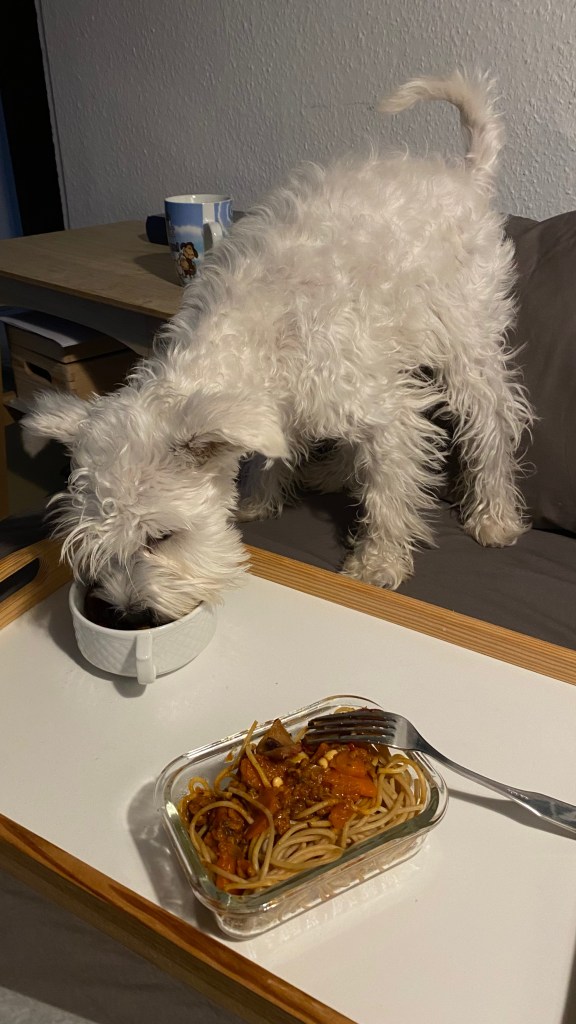
I’m still vegan–vegetarian, which made the first months… interesting.
Not killing animals personally, but buying their already-dead bodies for my dog and cooking them — that took adjustment. I tried feeding her raw, but when you travel, you simply don’t have access to consistent, safe supplies everywhere.
So cooking became the sensible compromise. And even if my dog doesn’t eat as much meat as she could, the financial impact is still very real. Just like any other child, she wants treats, of course. But not the cheap ones.
The high-quality, hypoallergenic, no-chicken-no-potato-no-periodic-table variety — the ones that remind you exactly why you hated chemistry in secondary school. I tried buying meat from Lidl and other hypermarkets, but eventually I realised that meat isn’t just meat. There’s cheap meat, questionable meat, surprisingly-watery meat, and meat that makes you question your entire life trajectory.
At some point, my financial balance was praying harder than I was.
But what wouldn’t you do to keep your child healthy, right? According to the HRS reports, a dog supposedly costs between $600 and $1,220 per year. Well… Israeli dogs must be living on the financial edge of the universe, because I have absolutely no idea how people here manage to spend so little. Either their dogs have lower expectations, or they all secretly run underground dog-food cartels. We definitely need to check the economic landscape, because something doesn’t add up. And that’s where the fun begins:
Dog ownership costs vary dramatically by country — and the numbers tell a completely different story than those polite American “$600 to $1,200” estimates.
Now, before your eyes glaze over at the thought of another polished economist’s report, let me break it down — what this fluffy little tyrant actually costs in the real world. Here is more or less the costs calculation I have for my four-legged Psiecko — and for comparison, what the economists would have you believe:
And the economists? They kindly tell you a dog costs between $600–$1,200 a year.
Reality check: if you treat your dog like a child — with fresh food, supplements, toys, grooming, medical care, and the occasional luxury item — the “average” estimate might as well be a bedtime story. Welcome to High Finance Dog Mum Edition.
But what if your economic struggle isn’t just about kibble and spa days for the dog? What if the costs escalate because of a certain narcissistic partner lurking in your past — or worse, still very much present in your current life? Suddenly, those carefully calculated budgets aren’t just numbers on a page; they become a high-stakes juggling act of vet bills, gourmet meals, and emotional inflation. Every new toy, every premium treat, every tiny indulgence for your four-legged companion feels like an exercise in strategic resource allocation — and that’s before we even get to the mental gymnastics required when your partner thinks your dog’s happiness is somehow negotiable.
The cost of a narcissistic partner, it turns out, isn’t only emotional — it can be painfully financial too. In my own case, it began innocently enough from the outside, but behind the scenes it was a subtle and relentless manipulation. My ex-partner started giving highly processed meats — salami, cured ham, other indulgent scraps — without asking me. And not in tiny amounts.
I had repeatedly explained that these treats were unhealthy, that my companion was already having some stomach issues. He would pretend to show concern, then ignore my request entirely. The issue wasn’t what he said — it was how completely he dismissed my boundaries.
What followed was predictable, yet shocking. My companion’s behaviour changed dramatically: begging at the table, jumping up, demanding the forbidden treats. A creature that had always been composed suddenly acted like a little junkie, a child deprived of their iPad. Every meal became a small battlefield.
And the fallout wasn’t just in behaviour. It came straight out of my wallet. Additional veterinary checks, supplements, vitamins, even medicated food — all of these became necessary because my instructions were ignored.
I am certainly not alone in this. Many people in narcissistic relationships find their pets weaponised as tools of control: a way to keep them tied to the household, to bend affection, to assert dominance. I happened to be lucky — my ex didn’t particularly care about animals, or perhaps he didn’t see a reason to pursue that route. But the pattern is familiar: when a partner realises that the creature you love most is a lever, it becomes part of their arsenal. Thankfully, I didn’t have to hire a full-time behaviourist — but many owners in toxic relationships do, after months or even years of subtle manipulation. Animals are, in their own right, affected by the chaos around them; just like people, they carry the emotional baggage of the environment you’ve subjected them to. A dog isn’t immune to stress, confusion, or anxiety — and when your partner is a narcissist, the fallout can be immediate and expensive.
Even after I managed to remove myself from the situation, the costs didn’t stop. It wasn’t just about getting myself to safety — finding a secure place, clothes, my own space. My companion needed a complete reset too: a new bed, fresh toys, even new bowls, because everything the previous partner had retained was part of a calculated plan to make me think twice about leaving. By holding onto our things, he hoped I’d come back, perhaps tempted to reclaim what was “mine.”
But animals, like humans, don’t understand manipulation — they just respond. And so the investment in their recovery becomes another layer of expense. Supplements, safe foods, calming toys, new sleeping arrangements. Each item a tiny reclamation of security, autonomy, and trust. Each pound spent a reminder that escaping a narcissistic environment is never just emotional — it’s financial, practical, and painstakingly granular. A narcissistic relationship, or any entanglement with a toxic partner, costs far more than just your own money and sanity. Every ounce of stress you carry — your companion feels it too. Your dog, like every living being, absorbs the tension, the chaos, the leftovers of manipulation. This is something we often forget. Dogs are sentient. They are not mere ornaments. They live, breathe, feel, and yes — they cost money, time, and energy. December is coming. And like every year, countless people will be tempted to buy a dog as a “perfect Christmas gift” — for the child, for the ‘Gram, for the illusion of joy. But think. Every burden you carry, every toxic dynamic you tolerate, your dog carries alongside you. Dogs mean commitment. Dogs mean work. Dogs mean a loss of freedom. And yet, I would never, ever trade my baby-dog for the world. Never. But the truth must be said: the cost of a living organism — a sentient life — can be enormous. I’m not talking about doggy bills alone. I’m not even talking about behavioural therapy after toxic relationships. Because you do not enter these situations alone — you bring your dog with you. And sometimes, that can be dangerous. Not because the dog bites, but because a narcissist can weaponise the animal against you, keeping it as leverage to trap you. Dogs are not gifts. Dogs are not cheap. They are living beings, and they deserve respect, foresight, and care. Treating your dog like a child, as I do, is my choice. It is not a blueprint. But never forget: a dog is life. And life is not something to be taken lightly. And let’s be clear: a dog is not just a cute accessory. A dog is a living being, a companion with needs, feelings, and a life to be respected. They require walks — sometimes three, even four times a day. They need medical care, attention, love, and emotional presence. Even on days when I feel I am falling short, I try my absolute best. I am not perfect — none of us are. We will never be. But what matters is the effort, the commitment, the choice to give our very best. That is what being a dog parent truly means.
https://www.quora.com/Does-a-narcissist-use-pets-as-a-way-of-getting-to-their-animal-loving-partner
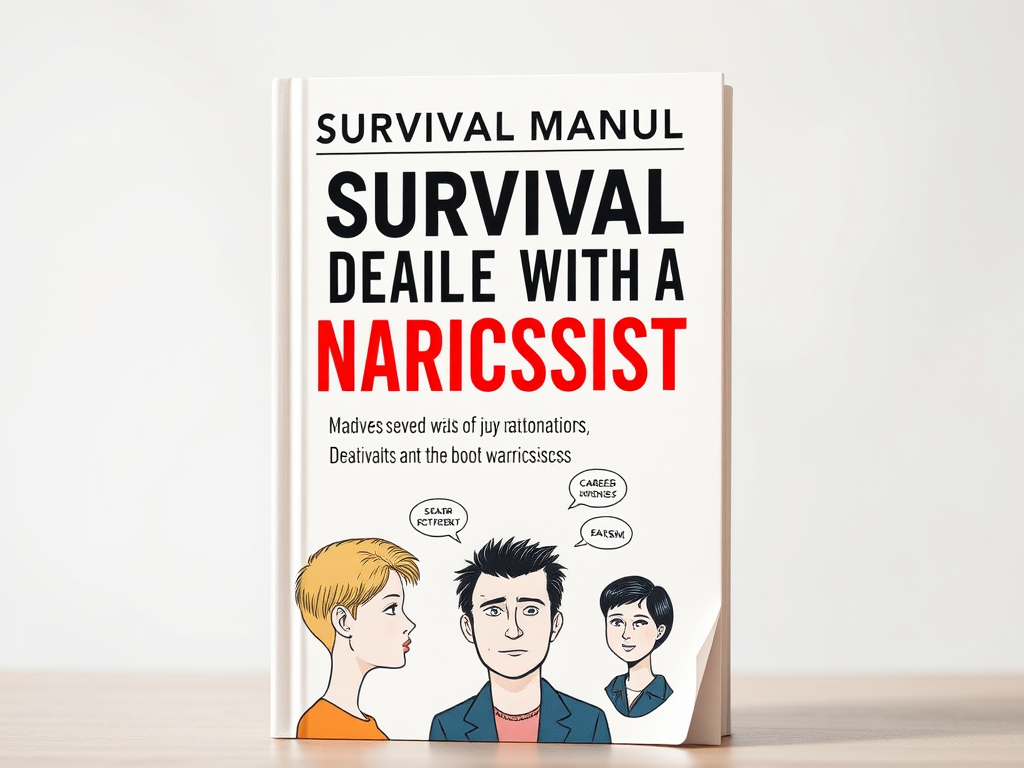
1. Career prospects? Consider them “on pause.”
I wish someone had told me that a narcissistic partner will suddenly develop a passionate interest in your unemployment.
They’ll call it “support.”
It’s actually asset control.
If they can’t manage their own life, they’ll make damn sure they’ll manage yours.
2. Emotional stability will be discontinued until further notice.
One day you’re “the love of their life,”
the next day you’re a “dangerous liar who probably works for the CIA.”
Consistency is for healthy adults — not for people who rewrite history every 12 hours.
3. Hair? Oh darling… prepare for structural collapse.
Chronic stress nukes follicles.
Dye won’t hold, curls won’t hold, dignity won’t hold.
You’ll walk out of the salon smelling like chemical warfare,
and the mirror will quietly whisper:
“Not your fault. It’s your cortisol.”
4. Weight? Volatile asset class.
You can eat three times your normal intake,
but your body will still behave like you’re auditioning for a famine documentary.
Narcissistic abuse isn’t just emotional — it is biologically inflationary.
5. Clothing expenses will skyrocket.
Sometimes because you’re replacing stress-ruined outfits.
Sometimes because you no longer have access to your own wardrobe.
Sometimes because you had to run out of the flat with only your dignity — and that one’s usually optional.
6. Police involvement is surprisingly on-brand.
I wish I’d known that narcissists have a unique talent for calling the police
to report crimes they imagined last Tuesday.
The charges?
You “stole your own belongings” or “looked suspiciously independent.”
Translation:
their own guilty conscience is overheating.
7. Their accusations are simply confessions delivered early.
If they claim you’re texting your ex,
you can safely assume they’ve already contacted theirs.
Projection isn’t a symptom.
It’s a full communication strategy.
8. Your self-esteem will drop faster than the British pound after bad economic news.
You start as a competent, attractive human being.
Six weeks later you’re asking the mirror whether it can rate your existence on a scale from “meh” to “worthless.”
Good news:
You’re still fine.
The environment was toxic — not you.
9. Recovery comes with a premium price tag.
Hair treatments, vitamins, supplements, sleep aids, therapy, new clothes, emergency travel, replacement belongings —
you’ll spend more escaping the relationship than you ever spent inside it.
10. And now… a quick note on healthcare.
You might assume professionals would know the difference between trauma, stress dysregulation and psychosis. Adorable. If you go for a personality assessment immediately after leaving a narcissist, your nervous system will still be talking in capital letters. And some clinicians panic when they see emotions outside a PowerPoint chart.
So do yourself a favour:
Don’t book an autism or personality evaluation during the post-narcissist-crash window… unless you fancy a surprise diagnosis you never ordered 😉
Final Takeaway
A narcissistic partner is like purchasing a luxury handbag that turns out to be a biohazard:
Expensive, unstable, and guaranteed to fall apart in your hands —
but not before taking your hair, your savings and your sanity as collateral.
Now listen — because this is the part none of us want to hear, but all of us need to internalise.
You are strong enough to shut this cycle down. Maybe not today. Maybe not with full certainty. But the strength is there — dormant, bruised, shaken, but absolutely intact.
Walking away from a narcissist is not romantic healing.
It is operational restructuring.
It is crisis management.
It is a full-scale turnaround project. And yes — it’s going to cost you.
Emotionally, physically, financially.
Especially if you’re living in a country where inflation bites harder than the breakup itself.
Hair loss recovery? Expensive and slow.
Nervous system repair? Even slower.
Medical bills? Don’t get me started.
But here’s the strategic truth:
You are the company.
Your body is the asset.
Your mind is the infrastructure.
Your future is the growth plan.
You don’t tolerate losses in your business —
so why would you tolerate a long-term deficit in your life?
Every day you stay in chaos is a sunk cost.
Every day you reclaim yourself is compound interest.
Your job now?
Decide. Commit. Execute.
Doubt is normal it only means you’re human. But indecision is fatal — it keeps you in the same quarterly disaster report. Bring your friends in. Tell them what happened. Say, “I need backup.” There’s no shame in assembling a support team. Even the strongest CEOs need a board. Healing won’t feel heroic at first. It will feel like dragging yourself through mud with shaking hands. But momentum builds quietly. Strength returns silently. And one morning, without fireworks, you realise: You’re back. And you’re already outperforming the version of you who stayed. This isn’t about surviving him. It’s about scaling you.
In debates across Poland and Germany today, one hears an increasingly familiar refrain: “Women don’t want to work.” Yet, for a significant number of survivors, the issue is not reluctance — it is not permitted. As I reflect on my own experience, I find it imperative to ask a difficult yet necessary question: What about the women who were never allowed to work because their partner’s narcissistic control made every step toward autonomy a threat?
The Reality of Economic Abuse
Economic abuse is not an abstract concept—it is deeply gendered, systemic, and highly consequential. Research clearly demonstrates that coercive control frequently manifests through financial manipulation and restrictions on professional life. A 2025 qualitative review in the Journal of Family Violence describes how survivors experience a constant state of “unfreedom”—a world where their decisions, mobility, and even finances are monitored, judged, and controlled.
Moreover, a recent meta-ethnography on financial abuse outlines a four-stage journey in such relationships: control is first established subtly, then openly exploited, before culminating in crisis and post-separation financial struggles. This is not just emotional or psychological abuse — it is a deliberate strategy to marginalise and silence.
Empirical economic research supports these qualitative testimonies. A rigorous study published in The Quarterly Journal of Economics found that women cohabiting with abusive partners see a measurable decline in labour market outcomes: lower employment rates, reduced earnings, and sustained financial suppression even years after leaving the relationship.
Coercive Control and the Prohibition of Work
In my case—and in the stories of many others—this played out in a very real, chilling way. My ex explicitly discouraged me from working, undermined my LinkedIn and blog presence, and presented my professional aspirations as a threat to his control. When I dared to send my CVs, I was met with rage. His world-view was binary: either I remain entirely dependent—or I am punished for my ambition.
This aligns with patterns documented in both research and clinical practice. Mental health professionals and counselling services emphasise that narcissistic partners often design hierarchical relationships, not true partnerships. The result? Emotional exhaustion, internalised self-doubt, and systemic suppression.
A Fatal Intersection: Religion, Identity, and Threat
In my story, the danger was not just psychological. My ex used religious identity—claiming protective networks, connections, and even a weapons licence—to intimidate, control, and isolate me. This is not just personal scandal; it is a manifestation of how power can be amplified in intimate settings when identity and ideology intertwine with abuse.
The Policy Argument: What Is Missing
• Structural Support: It is not enough to argue that “women should be pushed into work.” For many survivors, the barrier is not lack of desire — it is fear of death, threat, or reprisal. We need targeted support, legal protections, and therapeutic frameworks that specifically address economic coercion.
• Prevention & Education: Our public discourse should include awareness that not all economic inactivity is by choice. Narcissistic and coercive control often begin with undermining agency and escalate into full isolation.
• Institutional Accountability: Employers, hiring managers, and HR departments must understand that gaps in employment or “unusual career breaks” can indicate survival, not failure.
The Call to Action
This is not just a personal story — it’s a plea for systemic change. I ask:
• To policymakers: Why do we not have more robust legal recognition of economic abuse and coercive control in workplace protections?
• To social institutions: Why is there insufficient provision for women who have been financially and emotionally silenced by partners?
• To civil society: How can we better support those escaping narcissistic relationships — not only emotionally but professionally?
Freedom, in this context, is not simply about leaving. It is about rebuilding one’s agency, voice, and career. And for many women—like me—it is about proving, daily, that autonomy is not a crime.
I haven’t studied psychology.
But let me tell you something: I would bet my life that my ex-partner was narcissistic.
A narcissistic personality, according to clinical definitions, is characterised by:
• a pervasive pattern of grandiosity, need for admiration, and lack of empathy;
• manipulation of others to maintain a self-image of superiority;
• exploitation of interpersonal relationships for personal gain;
• persistent attention-seeking, control, and denial of responsibility;
• and a distorted perception of reality, where one’s own desires and interpretations always trump facts.
This was him. He would insist that I said things I never said. In his mind, I had promised, agreed, or acknowledged things that had never happened. And no matter how clearly I explained that I had not said or agreed to anything, he treated my denial as evidence of my dishonesty. Every time I said “No” to something, he escalated. He created new problems, invented new grievances, attacked me relentlessly until he had regained complete control. Even when I knew his demands were harmful to my health, I was forced to comply, because his stress, his threats, his manipulation were impossible to ignore. If I dared to point out that he was wrong, The very next day he would turn it into a crisis. I would wake up to more arguments, more accusations, more pressure. It was an exhausting cycle designed to dominate, to disorient, to break me down and it almost succeeded.
On Tuesday, 6 a.m., he “dumped” me.
But not because he genuinely wanted to end the relationship.
No — it was a tactic, pure manipulation.
A week earlier, I had asked if I could go somewhere alone. I needed permission to meet friends, to have a life outside him. He saw it. And then, like a predator testing boundaries, he created chaos to force me to comply. That morning, I had to calm him down, negotiate my freedom, because he was running around, creating panic, threatening danger, pushing toward an “accident” all to make me beg him to come along. It felt like something out of The Vampire Diaries: he can’t enter your world, he can’t take space in your life, unless you let him in. And he used fear, aggression, and sheer psychological pressure to make me open the door — literally and metaphorically; to his control. I had no choice. I had to plead with him, ask him, convince him, to just accompany me. It wasn’t love. It was control. It was power. And I had to surrender my autonomy, my day, my freedom, just to survive the morning. Wednesday was the day everything in me felt broken. I had sold my apartment. I had laid down my life like an open heart on a cold table. And he was standing behind me, over my shoulder like a controller, like a pimp checking how much his girl “earned.”
I was at the notary. I just wanted to change my address. I wanted to handle my own matters like a normal person. But every time I opened my mouth, he interfered in things that were none of his business, in decisions that shaped my life, not his. He watched my hands as if I belonged to him. He scrutinized every move so coldly, as if I existed to serve, not live. When I handed over the keys,
he got angry. Not because it concerned him but because I wouldn’t get money anymore.
Because I had done something outside his control. And when I said,
“I have no apartment now. No money. Great.”
he wasn’t upset. He wasn’t worried.
He was only angry because he couldn’t dominate the situation. He criticized me,
corrected me, picked apart every detail, as if I were an employee who broke the rules. I was distrustful, extremely distrustful, and he knew it. So he increased the pressure. He spoke, he stabbed, he prodded, until I felt like a woman under constant supervision, controlled, monitored, diminished so I wouldn’t realize that my life was burning around me. He bought me a rose. A single, stupid rose. And while I was standing there, asking the only sane question left in my body –
“What is happening between us?” –
he stared at me as if the question itself was offensive.
“I don’t understand why you ask. Of course we are together.”
No.
We were not. He had broken me.
Tuesday morning, 6 a.m., he had ended it. He had crushed me. And now he simply refused to acknowledge the breakup. As if reality didn’t apply to him. As if my boundaries were a joke. That was the exact moment I realised:
I wasn’t a person in his world. I was a projection screen. A surface for his fantasies, his delusions, his control. I wanted to buy something small to soothe myself. A tiny moment of agency. But he dismissed it instantly because he had ordered tyres for his Mercedes and we had to be at his mechanic by 3 p.m. So my choices shrank to almost nothing.
I was allowed one task: buy food for my dog. Everything else was off-limits. Everything always had to follow his timeline. His routes. His moods. His priorities. I was not living. I was being dragged.
On the way, I learned the real accusation he held against me:
that I didn’t call him “baby,”
that I didn’t use “honey,”
that I didn’t speak to him in cute, infantilising pet names. To him, that meant I didn’t love him. That was the foundation of his rage. And inside I thought:
What the actual fluff?
He promised I would “not regret it.”
While I promised myself that we were not together, and I would never treat it as such. That night, he tried to arouse himself on me again. His hand moved straight between my legs, without invitation, without softness, without care. I flinched. I said, “Not today.” He got furious. So I rushed to explain, inventing a story about maybe having an infection, because something in my body felt wrong.
The truth?
My body was healthy. I was shutting down out of fear.My nervous system had gone into lockdown. Touch felt like electricity.
He didn’t notice. He didn’t care. He slept on the couch. I slept in the bed. The silence was full of barbed wire.
THURSDAY — THE BREAKPOINT
By Thursday night, my body was running on emergency mode only. No strategy, no resources, just survival. I tried—one last time—to coach him out of his spiral, to apply calm where there was only chaos. And then it happened again. He stormed out of the house like a man chasing his own demons. Seconds later he burst back through the door, not as a partner, not as a human being even, but as a violent storm wearing a face I once trusted. He screamed that he didn’t give a damn about me. He screamed that he didn’t give a damn about the synagogue. He screamed until the walls shook and my muscles locked up so hard I couldn’t breathe. There was no reasoning, no negotiation path, no escalation protocol that could work on someone already detonated.
I was standing there, waiting for the hit — because everything in his posture told my nervous system, it’s coming.
I felt my heartbeat in my teeth.
I felt my spine turn into glass.
And I did something I never imagined myself doing:
I touched his face, lightly, not in aggression but like someone trying to interrupt a nightmare. Then I pressed myself against him, closing the distance so he couldn’t keep screaming at me, whispering:
“You’re going to hold me until you stop.”
Because I knew if I didn’t anchor him with my body, he’d tear the whole house—and me—apart with his rage.
And while I was clinging to him, terrified and shaking, one thought kept cutting through everything:
I’m not safe.
Not with him.
Not even for a second.
FRIDAY — THE DAY MY NERVOUS SYSTEM SNAPPED
Friday began before dawn, long before any sane person should have to face the truth.
At 4 a.m., he sent me a wall of messages — a digital avalanche designed to crush my will. In those messages, he “ended things” with me. Not because he truly wanted to end anything, but because the night before, I had dared to want one morning of peace. I had told him I needed to leave early, alone. And in his world, a woman who wants to do something alone is a direct threat to his control. He stormed off to the gym after sending the breakup message, but not before making sure I felt like nothing. He oscillated between “I want nothing to do with you” and desperate clinging. Between hatred and the need to press his body against mine. Between rejection and possession.
The inconsistency itself was the cruelty. I stayed silent, packed my things, and prepared to leave while he was lifting weights and pretending to be the victim. When he came back home, he laid his feet on me first, then his hands — a gesture he used often, a silent claim:
I own you. You stay.
That’s the moment the cramps hit me. Sharp, twisting pain. Lower abdomen. Sudden nausea. Not because I was pregnant — but because my body couldn’t hold the stress anymore. He noticed. And immediately, he tried to use it. He tried to hold me in place until my period came, because in his fantasy, the idea that he might become a father gave him a sense of legacy, of importance. My body became a stage for his delusions. That was the moment I took a pregnancy test. Not out of hope — out of sheer fear and pure biological panic. He hovered over me the entire time, watching, monitoring, calculating. When the test came back negative, relief washed through me — but he didn’t care about my relief. He cared only that his imaginary future had evaporated. Then the rage began again. As soon as I said I couldn’t go with him to his company, because I had a train to catch, he lost control completely. He shouted that I was “talking nonsense”, that I must wait for him, that he would be home soon and we would “talk like adults”. Except talking with him never meant talking. Talking meant being worn down until I broke. I tried to pack faster. I was shaking. I wanted to run. But he came home half an hour earlier than he had said. He burst through the door in full meltdown mode — crying, hyperventilating, swearing he couldn’t live without me, demanding I come with him to his workplace so he could “function”. I gave in. Not out of love, not out of loyalty — but out of survival instinct. I said, “Fine. I’ll come with you. But after that, I must go to my father.” He agreed. And of course, he lied. When we arrived near his company, I learned that he expected me to wait outside like a dog, in the cold, while he spoke to his boss. No explanation. No consideration. Just the assumption that I would obey. But Friday night was the real breaking point. He followed me while I took the dog out, acting like a shadow, a supervisor, a warden. It was Halloween, and at first I thought my dog was afraid of the costumes. But the moment he sprinted to his car and drove off, my dog relaxed. Walked normally. As if the monster had left the street. He said he’d be back in half an hour. He wasn’t. So, I saw his key still sitting in the door lock, like a silent alarm bell nobody else could hear. I asked ChatGPT what I should do, because he had left crying, and for almost two hours there was no message, no step back through that door, nothing.
ChatGPT told me to call the police. And here comes the twist. This is the first time in my life I truly regret not listening to ChatGPT.
I’m sorry, ChatGPT, that I didn’t hear you. I should have.
But I panicked. I preferred to call him, over and over, because I had started to believe that he had friends everywhere — eyes, ears, invisible alliances — and that because of my past no one would ever believe me anyway. So yes, I called him like someone who has run out of breath and logic. On the third attempt he finally picked up. He said he was driving to the graveyard, crying into the phone, on his way to his parents’ grave. I told him he wasn’t capable of driving like that, that he needed to turn around and come back home now. He answered that he didn’t care — that if he died, at least he’d be on the “right” road, and no one would care anyway. And I pushed back, telling him that this wasn’t true, that he needed to come back, that he couldn’t just disappear into the dark like that. So he came back home an hour later, crying like a baby. He asked me to sleep in the bed with him. I told him no, I have a five-hour trip tomorrow, and I need to be relaxed. Besides, we are not together anymore, and I don’t want to come back. It’s enough. Still, I stayed with him a while, trying to talk him down, trying to help him calm. Because here’s the thing we must never forget: narcissistic people are not inherently bad. They are just terrified, incapable of caring for their own emotions. They are the most insecure people you will ever meet. But the problem is, no one ever tells them how to return to security, how to be secure on their own, how to wrestle with their feelings. Most of us only see them as toxic, and we stop at that. Why try to understand something so enormous, so crazy? But I saw a child abandoned by a mother. I saw an old man who couldn’t manage his emotions. And mostly, I saw my mother in him. They acted in eerily similar ways. That’s why I knew I had to go — this breakup, this forever. On Saturday, during breakfast, we talked. He said he finally understood what I meant when I told him how much he had hurt me. He even brought me flowers — six roses. And here’s the Slavic nuance: as a Slavic woman, you know that giving six roses is… complicated. In our tradition, certain numbers carry meaning — seven, nine, etc. Six is almost a “small gesture,” not the grand romantic statement he probably thought it was. On Saturday, during breakfast, we talked. He said he finally understood what I meant when I told him how much he had hurt me. He even brought me flowers — six roses. Now, here’s the thing about Slavic tradition, from my own eyes and upbringing: the number of flowers actually matters. Odd numbers, like three, five, seven, are for life, for celebrations, for joy, for romantic gestures. Even numbers… well, those are reserved for funerals, for loss, for endings. It’s as if the universe wants you to count your blessings—or your miseries. So when he handed me six roses, I couldn’t help but notice the mismatch. Six, in our world, is polite. Safe. Mildly affectionate. It’s the number of flowers you give if you want to say “I thought of you, but only just enough.” Not passionate, not daring, not the slightest hint of boldness. And for someone like me, raised to notice these little cultural cues, it wasn’t just flowers — it was a subtle reminder that gestures, even romantic ones, don’t exist in a vacuum. They carry history, expectation, and a tiny hint of judgment.
We went because I didn’t know this route—we had never driven this way before. He suddenly told me we weren’t going to the train station, but to some other place, where he expected me to “spend some time” until I changed my mind about the breakup. I was terrified. I tried to open the door, but he blocked it from the driver’s side, which made me hate the Mercedes even more. I was frozen, scared out of my mind, and yet, I had to plead with him to just open the door so I could go to the train station by myself. He looked at me, completely bewildered, as if seeing me for the first time in his car, and asked, “You’re really afraid of me?” I said yes, without even thinking. He drove me to the train station, helped me with my luggage, but made it crystal clear: he would only let me go if I promised to call him when I arrived. I said okay, though I never meant it. Five hours later, he called obsessively—five calls—until I told him to stop and blocked him. Monday morning, I locked my laptop, but it wasn’t connected to the internet, so it didn’t register that I had blocked him. By the time I checked, I had thirty new messages from him, all about his suffering, all about how much he had “learned,” and most of them made me panic. One particularly disturbing message demanded my address. He even sent a navigation screenshot, claiming he was in his car waiting for the address because he was “on the way to Gdańsk,” where I was supposed to be. I almost freaked out completely. By Monday evening, he started sending messages from his work phone. On Tuesday, he told me I should pack my things because “a war is coming at the start of December,” claiming he knew this because of his friends and that we would all die if we didn’t leave the country. I told him I didn’t want any contact, that we were no longer friends, and that I would text him when I was ready to pick up my stuff. I reminded myself that he had allowed me to pick up my belongings, even if he wasn’t there. After consulting with ChatGPT about whether I should go, I decided to go with my best friend to collect my things. Immediately, this made me a criminal in his narrative. His neighbour called him the moment she saw my friend carrying anything out—she hadn’t even seen me—and he ran to the police like a small child who lost their parents. He accused me of taking his possessions without permission. When the police arrived, I was able to show that he had given me the key, that he had messaged me from a fake Facebook account giving permission, and that everything I took was mine. Yet he insisted that I should be detained for 48 hours and that my dog should be put in a shelter. To save my dog, I agreed to only keep my documents and put the rest of my belongings back in his apartment, including my vibrator, underwear, and shoes—because, in his deranged mind, my underwear belonged to him too.
Yes, that is both absurd and perverse.
After the police saw all the evidence proving I hadn’t done anything criminal, they were ready to leave—but then their superior called and said I should be held for 48 hours. As they tried to explain why I should leave all my belongings behind and only take my documents, I panicked. When they called him, I didn’t want to, but I complied because the police are authority and I wanted to cooperate. Hearing his voice sent me into a full-blown panic attack—I could barely see, felt blood rush in my head, couldn’t breathe. I used my inhaler, shaking. The officer asked if I wanted to go to the hospital; I didn’t, I just wanted to get out of there. I was terrified. How often does something like this happen? You try to take what’s yours, and suddenly you’re the criminal?
With the help of my friend, we managed to get through it. The whole town already knew the story, that I was the “criminal” who tried to harm this poor man. The police told me that if I didn’t have the keys to his apartment, I should send them by post. I did. But the keys never arrived. It was Sunday and they were still missing. I texted him after sending the keys, and he immediately went ballistic. He accused me of lying, of “playing with him” because I had gone to theater school, claimed everything I did was nonsense, that I owed him, that I would take his money. I was stunned—what money? I’d just sold my apartment. In that moment, I realized I was trapped in the same manipulation loop, where even my friend, who witnessed his attacks, was shocked. He had attacked my friend too, threatening he’d lose his car, claiming debts. Everything was twisted to make me feel guilty. I tried to reason, but he refused to let it go. I wished him a good life and wanted both of us to be safe and free—especially for my dog. I was completely drained. At one point, I screamed in the car, the kind of scream that feels like it’s trapped inside your head, invisible to the world. He kept calling, frantic, until my friend drove me to the hospital. Only then did he stop. My friend called him from the hospital, but he never checked if I was actually there. Instead, he sent messages claiming he loved me more than his parents. Love for him is possessive, controlling, and violent. He continued texting the next day and the day after, apologizing for “hurting me,” but still convinced I had stolen from him. I kept every message and screenshot, sending them to my friend. He then demanded when I would pick up my belongings—but only if he was present. I said, after the hospital stay, that my psychiatrist advised I not be alone with him, and he feigned ignorance. He acted as if he had no idea I had even been hospitalized. On Sunday, he accused me of expecting him to attend some Jewish holiday thing and said he had spoken with a rabbi about me. I asked why he discussed me with strangers. His excuse: “Nothing serious.” I reminded him: I’m not your wife, we are separated, and I am Muslim—please respect me. Two days passed in silence, but yesterday he left voicemails saying he had talked about me at the gym, demanding I email the gym. He lied to the staff that my father was sick, and that’s why I wasn’t attending. I called the gym to clarify. The manager said they would not release my information to him, but I couldn’t stop asking myself: am I truly free? Am I really single if I’m constantly battling him, even from afar, no matter where I go, because he knows I have contacts? So here’s the real question: how free is one after breaking up with a narcissist? How far do you have to go—how far must you move or what legal steps must you take—to actually feel free from them?
https://www.marriage.com/advice/mental-health/narcissist-break-up-games/
https://www.choosingtherapy.com/breaking-up-with-a-narcissist/

My dear friends, I know I’ve been absent for a while. I was, let’s say, involved in a relationship. And yes, it was a truly terrible idea – I know, we all make mistakes, don’t we? I met a man, Darek, and as you may know from previous articles on the blog, it was quite a diplomatic incident. I entered the relationship because of his profession, or rather, what he claimed his profession to be. He was supposedly a soldier in the past – which, logically, should imply self-control, discipline, and composure. Unfortunately, I was mistaken. My expectations – that I could follow him, that I could surrender because he had a purpose – were completely off the mark.
He felt threatened the moment he realised that I did not need him. He told me stories of how many bones he had broken, how dreadful his former partners had been: one cheated constantly, another was a “prostitute” who slept with a colleague, the third took half his flat when leaving. And he – he was always the good one: faithful, patient, rescuing these women, practically bringing heaven to earth for them. And how were they in return? Ungrateful. They stole from him, betrayed him, and hurt him. He boasted about contacts in the prosecution, high-ranking police connections… but did he ever actually listen to me? Of course not. He only heard what fit his own narrative. And do you know what, my friends? After two months of endless conversation, he only truly registered one thing: that I had attended theatre school as a child. That single piece of information was enough for him to label me a liar – despite the countless times I proved that I had never taken any of his belongings or touched his wallet. I even lent him my own money so he could feel comfortable. No matter what I said or did, no matter how often I cried, or how intense my migraine attacks were, I was never able to convince him that I wouldn’t hurt him. Sometimes, all it took was a simple smile from me in the middle of the night – when I was barely breathing from pain – to make him feel diminished. He told me he was a man, that he had never been wanted by his mother. And yes, I felt sorry for him that he had to endure that, though we all carry our burdens, especially when life has pushed us. He would endlessly recount his stories, and if I tried to speak, he would twist my words into what he believed I had said, or that I ought to have said. The irony is that he often felt, at moments when he forgot himself, that he was inferior to my intelligence. He admitted, more than once, that he knew he wasn’t as clever as I am, and that he frequently felt intimidated by my mind. I, however, did everything to avoid making him feel like he wasn’t enough. I even suggested we read a book together – self-education is, as we all know, vital – and he flatly refused. On more than one occasion, during arguments he instigated, I told him plainly: “I’m simply trying to challenge your potential. I am not like the other women you’ve known. I see your capacity, and I want you to use it.” And yet, he felt humiliated. In the end, the only words I was allowed to speak were things like “darling,” “baby,” or “kitten” – all those cutesy names I would never use unless I was genuinely annoyed. Friends, I must confess: I only ever use such names when I truly do not respect someone, or when I’ve forgotten their actual name. He expected me to take all the blame for every single argument we had. Often, I even showed him how he had hurt me, but he refused to acknowledge it as injury. At some point, I asked ChatGPT, “What’s wrong here? Am I the one who’s crazy?” ChatGPT explained that I was likely dealing with a narcissist. Whether that is strictly true, I cannot say—but every time I read about narcissism, I felt like I was reading about Darek. Of course, this is not a diagnosis, merely my own observation. One fact, however, struck me as particularly revealing. Whenever he found himself completely cornered—when I presented every piece of evidence, including messages I had sent him, which he interpreted as humiliation simply because they did not say “I love you,” or “my baby, darling, kitten,”—he immediately resorted to invoking his religion. In these moments, Karl Marx’s words come to mind: “Religion is the sigh of the oppressed creature, the heart of a heartless world, and the soul of soulless conditions. It is the opium of the people.”

He clung to his Jewish identity every time he lost an argument. I never fought him. I simply defended myself, until eventually, I wasn’t even sure who the crazy one really was.
I started to seek out information, trying to understand why I felt constantly drained despite sleeping enough. I was losing weight rapidly, even though I ate plenty, and in the last two weeks before the end of the relationship, I noticed persistent migraines and frequent abdominal cramps after every meal. I could barely manage a small yoghurt without pain. Naturally, I turned to the internet for guidance, looking for explanations and support, because at this point, everyone seemed determined to question my experiences.
What I discovered was both enlightening and chilling. Research shows that relationships with individuals exhibiting narcissistic traits—grandiose or vulnerable—often involve manipulative tactics known as gaslighting. A 2023 study in the Journal of Family Violence found that these personality traits strongly correlate with behaviours designed to undermine a partner’s perception of reality, fostering doubt and self-blame. In other words, what I had been experiencing was not just in my head.
Furthermore, a 2024 systematic review on gaslighting emphasises that such manipulation is usually subtle at first, evolving into a pattern where the victim’s autonomy is continuously questioned and their sense of reality distorted. It confirmed for me what I had already felt: it wasn’t me being “too sensitive” or “irrational”—it was the consistent exertion of control, the rewriting of conversations, the selective hearing of only what served his narrative. Science, it seems, had finally validated my lived experience.
https://dergipark.org.tr/en/pub/pgy/issue/76970/1281632
Last Tuesday, at precisely 6:30 a.m., he broke up with me. He knew that I intended to travel alone to another city to sell my flat, and, as it seemed, he simply could not handle the idea of me going alone—he apparently planned to come with me. On Monday, I had already asked him not to interfere, that I had specially booked an early train so that I could leave in peace. My goal was simple: tidy the flat, sort through documents, and take care of a few bureaucratic errands. But, predictably, what did he do? From 6 a.m. onwards, he launched a full-blown morning assault. By 6:30, he had broken up with me again. Then he began crying and, of course, wanted to cuddle. The problem, once more, was me. As he lunged at me with rapid movements, my body instinctively recoiled. Seeing this, he ran out of the flat in tears—truly, in every sense of the word. He returned shortly after, claiming that he had tried to get into a car accident because I had “hurt him” so badly and he no longer wished to live. He told me he’d tried to crash his car to end his life just to see whether I would lie to him on his deathbed and finally tell him that I loved him. I looked at him and said that if he truly had done that, he would not only have destroyed his own life, but also that of some innocent person who happened to be on the same road. I told him that this kind of “gesture” wasn’t proof of love; it was proof of arrogance—the arrogance of someone who cannot think beyond his own pain. And, to be quite honest, the timing couldn’t have been worse. I had things to do, trains to catch, documents to sign. I told him I would not be able to deal with such melodrama before Thursday, and that if he ever dared to drag another soul into his self‑destructive theatre, I would hate him for it. He waged his little war until I finally relented, offering to let him come with me. Suddenly, the storm was over. No stress, no theatrics—at least for a moment. And what did he do next? Without hesitation, he thrust his hands into my intimate area. I looked him dead in the eye, removed his hands, and said firmly, “That’s sexual harassment. Even in Poland, it’s illegal.” He laughed it off, claiming he was “only joking.” No, this is not a joke. It was assault. I had to wait until he was finished before I could resume my day. During this time, I baked pumpkin cookies. He entered the kitchen and, in his usual self‑aggrandising manner, declared, “This looks like newborn crap.” I stared at him and replied, “You are primitively vulgar. Do you even hear yourself?” He countered, “What? I’m just speaking your language.” Except, of course, I would never describe food in such a manner. And, frankly, he didn’t even need to eat it—no harm done. Admittedly, I had forgotten the sugar, so the cookies weren’t perfect. But the crucial point is: he got exactly what he wanted. In the end, he did come with me—reluctantly, of course—while I finalised the sale of my flat. And, naturally, it became yet another exercise in chaos. My correspondence address was disrupted, bureaucratic details were complicated, and he spent the entire time attempting to “correct” me, even in front of notaries. Apparently, my own words were never enough; he always knew better. Once the flat was officially sold, he presented me with a rose. Not spontaneously, of course—he had calculated this move after I casually mentioned that the most beautiful moment I had ever remembered after waking from surgery was receiving a rose from my best friend. Cleverly, he figured that if he gave me a rose, he could manufacture the “most beautiful memory.” The irony being, we were no longer together, even though he still insisted on cuddling. Throughout the day, I couldn’t complete my official paperwork as I had planned, because he was there, and with his car tyres scheduled for delivery, we were forced to leave earlier than I wished. The following day, he insisted that he understood his mistakes and promised I wouldn’t regret being with him. By Friday morning, of course, all previous promises were meaningless. We were back at war before dawn. On Thursday, he had received a call from his employer, which sent him into a frenzy—running through the flat, flinging doors, behaving like a hysterical child. I was terrified. I tried to stay calm, to soothe him like a mother calming a three‑year‑old through emotional turmoil—but this wasn’t a child. It was a grown man, stronger than I am, screaming that he didn’t want me, that he didn’t care about anything, not even his work. On Friday morning, I woke to a text in which he declared he no longer cared about the Jewish community, no longer wanted to work there, intended to leave on 15 November, and claimed he was breaking up with me—again—because that’s what his therapist and “everyone else” advised. But really, how many times can one break up with someone before the act itself becomes exhausting? And can you even “break up” twice in a row, when you never truly reconciled after the first?
By Friday, after reading yet another message in which he “broke up” with me, I began packing instinctively. This was not an act of extravagance, but a desperate attempt at control over my own life. He was at the gym when he messaged me repeatedly, insisting I accompany him to a meeting concerning work. I told him I could not, explaining my schedule and commitments. Instead of respecting this, he issued commands: “Wait for me until I return.” His tone left no room for negotiation. His moods shifted unpredictably, as wildly as the autumn weather: from tears to anger, from fear to irritation. Eventually, we drove to the meeting. Despite my resistance, he claimed gratitude and begged for a second chance. I told him clearly that I could no longer participate in this back-and-forth; I was heading to my father’s grave the next day. He persisted, demanding my address so he could accompany me. I refused, pointing out that I had no intention of meeting anyone else, yet he assumed otherwise, believing I might visit an ex. During this time, he repeatedly attempted to physically assert control—pressuring me to be close, to allow unwanted contact. I refused, standing firm: we were definitively separated. At one point, a sudden abdominal cramp caused me to instinctively clutch my stomach. He panicked, asking if I might be pregnant. I responded sharply: even if I were, he would never know—the child would never be born. He pleaded for a few days of false reassurance, demanding control over my presence, ignoring my basic needs, including taking my dog out. Later, he attempted to trap me further, calculating that without a key, if he returned at 1pm while I had a train at noon, I would be unable to leave. I panicked, unsure of what to do. I contacted Chadjipiti, who immediately advised calling the police. In hindsight, I know this was the correct course, but fear of his connections and the possibility that my concerns would be dismissed prevented me from doing so. Instead, I called him repeatedly. Eventually, he answered, vague about his whereabouts, claiming he might arrive “tomorrow.” I was left feeling utterly powerless—like a mother confronting a child she can no longer manage, but in this case, the child was a grown man with far more physical power. Psychological studies of narcissistic manipulation, coercive control, and gaslighting consistently demonstrate the mechanisms I experienced: the alternating reinforcement of fear and appeasement, the exertion of control over basic daily actions, and the strategic creation of dependency and anxiety. Victims often hesitate to involve authorities, especially when the abuser holds social credibility or institutional connections, leaving them trapped in cycles of fear and hyper-vigilance. My fear was rational; my indecision was survival.
He agreed, finally, to come home. How considerate of him — or so it seemed.
We talked a little, the kind of talk that exists only to delay the inevitable, and then he asked if he could sleep in my bed.
I said no.
“We are not together,” I reminded him. “Please don’t take it personally, but I don’t want that anymore. I have a train tomorrow.”
He reacted with that particular brand of despair men often use when control begins to slip from their hands. Depressive, wounded, theatrically fragile.
And though I thought I had grown immune to it, his sadness still triggered guilt in me — the kind that seeps in through cracks logic can’t seal.
But guilt for what, exactly?
For him ending the relationship? For the insults? For the manipulation?
Even when I recognised it as irrational, the feeling stayed.
The next morning, he offered to drive me — and my dog — to the station. On the way, he mocked me lightly, saying he could never understand people who pack as if they’re moving house for just two days away.
I looked at him and said, “Darek, you broke up with me. I’ll contact you when I find something new.”
He didn’t like that.
He pleaded with me to leave my things, to come back, to give him another chance.
When I finally got into his car, he took a completely different route.
“This isn’t the way to the station,” I said.
He smiled faintly and replied, “We’re not going to the station.”
My pulse spiked.
A panic attack began to claw at my throat.
I begged him to stop the car, to let me out.
He laughed, half‑shocked, half‑amused.
“Do you really think so little of me? Are you truly afraid of me?”
“Yes,” I said.
Something in my voice must have convinced him, because he finally turned around and drove to the station.
He helped me load my bags into the train. The last thing I saw was his face — tears streaking down, disbelief painted over regret. He could not comprehend that this time, it was real. That I was truly leaving.
He kept calling. I ignored it. Eventually I sent a single message: It’s okay. Everything’s fine.
For me, the story ended there. For him, it had just begun.
When I opened my laptop later, the screen flooded with over thirty unread messages.
Some begged for my location. Others contained screenshots of his navigation app, showing he was already in the car, “on his way to pick me up.”
He wrote, “Send me your address. I’ll come for you.”
And all I could think was: Boy, I didn’t run away so you could come fetch me.
It’s like a murderer chasing his victim and calling after her,
“Darling, why did you run? I only wanted to kill you.”
I must have been insane ever to consider going back.
And no, don’t worry — I’m not crazy. I’m just tired. Utterly, clinically tired.
After hearing his voice messages, I realised I was utterly terrified of his voice. My heart raced, my whole body trembled, and my stomach started acting up again. I decided to go and collect my things while he wasn’t at home. Of course, I’d blocked him everywhere. Yet he continued texting from his work number. I replied that we are neither friends nor acquaintances, and asked him to stop. I kept my messages distant, as he had started trying to provoke me. He took my actions as a personal affront, felt insulted, and did not contact me further.
On Saturday, I went with my best friend to collect my things: my favourite blanket, three cooking pots, photos, documents, and my notebooks for further study. But here’s the twist—he didn’t approve. During the visit, his neighbour called him and, at his prompting, asked the police to intervene. The police, however, couldn’t find any criminal wrongdoing on my part, since I had received the keys voluntarily during our relationship. Even though I could prove I was merely collecting my belongings, the officers insisted I return everything from the car—including my underwear, which was utterly absurd—and place them back in his flat with the help of my assistant. I thought it was a bad joke.
When the police instructed me to call him and I had to hear his voice again, panic and terror washed over me. I had a severe asthma attack, felt dizzy, and nearly blacked out. I collapsed to the ground automatically. I tried to stand again, but my body seemed to have forgotten how. Simply hearing his voice had overwhelmed me entirely. He had informed the officers of his “rights” but made no attempt to explain himself. I concluded he thinks he knows everything; he is a walking encyclopaedia of the system’s rules. For a moment, all I could see was black. My best friend gave me an inhaler, and slowly I began to feel a little better. The police didn’t know how to communicate with me; I was in shock and could barely process what was happening. My friend explained to the officer that I have autism and that, under such stress, I might not fully comprehend instructions. I even began texting the officers in German, because my Polish suddenly sounded like a foreign language to me, and I felt extremely unsettled. The officers agreed that he was a complete idiot. I explained that he had tried to alter my documents, that he had contacts at the prosecutor’s office and the highest levels of the police, and that he would probably punish me for it. By the end of it all, I was genuinely afraid. And yet, he scolded me over the phone, claiming that if I hadn’t brought the man with the ponytail, done exactly as I was told, met with him, and collected my things, none of this would have happened. In his mind, he convinced himself that he didn’t know me at all, that I was the one stealing from him, lying to him constantly—because, as I’ve said before, I had attended theatre classes as a child.
He kept ramping up the threats. He’d told the neighbour to note down the licence plate of the car I’d come in and boasted that he’d watched it all on camera — that on Monday he would review the footage and prove beyond doubt that I’d stolen from him. As if I’d masterminded some great heist against the poor, wronged man. I didn’t know what to say. I tried to keep my composure, but I was under extreme stress. And yes, maybe the two times I collapsed from being overwhelmed look to some people like an act — but I did not pretend. I genuinely lost control of my body. Before we went to collect the things, my best friend and I drove to the police station to hand over the spare keys. The officer said he could not accept them. For a second I was stunned — “What am I supposed to do with the keys?” I asked. The police insisted: either post the keys or arrange to meet the man in person. I had no wish to meet him, so I posted them, just as the officer instructed. Unsurprisingly, that simply escalated matters between me and him. If I ever write a CV, perhaps I’ll list my skillset honestly: “Excellent at provoking escalation.” 😅
After I’d left my things there and the police had allowed me to take my documents, I decided for myself: I will never have a boyfriend or a man again. I’ve had enough. But of course, it wasn’t enough for him. He wasn’t finished with me. He claimed that he had called me and that I’d supposedly said I was a police officer. I proved to him that he was lying — or mistaken — that he hadn’t called me at all. He insisted he had witnesses. I smiled into the phone and said, “You didn’t call me. I’ve got the call log right here — I can show you.” I sent him a screenshot, and that’s when his mask slipped. He didn’t even think before replying; he just wrote that he didn’t believe me, that maybe he was mistaken. Then I called him and asked, “What’s your problem?”
He said he didn’t understand why I was calling, that he didn’t want to talk to me. I forced him into the conversation anyway. My best friend couldn’t take it anymore — he couldn’t stand hearing me constantly trying to explain myself for things that weren’t even my fault. I’d reached the point where I no longer knew why I was calling him at all. But maybe that was the point — maybe I called just to calm everything down again. I sent him the poem I had written for him, the one that had once calmed him down that Friday, that had supposedly touched his heart. But this time he said I’d faked it all. That I was an actress. Because, after two months, the only thing he remembered from everything I had ever said wasn’t that I wanted peace, not that I didn’t need a relationship to feel whole, not that I knew I was attractive and didn’t need anyone else’s validation — no. The only two things he remembered were:
first, that if he didn’t contact me for half a year, I probably wouldn’t even notice; and second, that I didn’t need him. Here’s the twist: I really wouldn’t notice — not because I’m cold, but because I grew up in the time of landline phones. Phones nailed to the wall, where people still sent Christmas cards, not WhatsApp messages. Back when everything felt closer, even when it was far away. I grew up at the dawn of telephones. I have friends I speak to once every six months, and it doesn’t bother me. Because I also grew up understanding that we’re all adults now — and that maintaining friendships in adulthood means saying things like, “I’ve got time in March 2027 at 1 p.m.” — “Perfect, I’m free on April 2nd at 11 p.m. Let’s make it happen.” 😁 I learned to give people space — as much as they need. He, on the other hand, only ever learned control. At least that’s how he showed himself to me. And I’d probably still feel guilty even if I’d been the reason for something, because I’d written to him everything I’d felt — listed what I had done, what I’d accepted even though I hadn’t wanted to. That includes the possibility of being pregnant. He called me, and I handed the phone to Karol and asked him to drive me to the hospital. After my best friend called him and told him he was waiting outside the hospital — that the doctors had given me sedatives and were examining me because I was in bad shape — Darek still talked only about himself. About how he allegedly loved me more than his own parents. About how, when one’s in love, one goes mad and becomes irrational. Until Karol finally hung up. And in that moment, I understood: the only thing he truly loves is the illusion of my powerlessness. The only thing he can handle is seeing me as his projection. And I am worth so much more than being someone’s toy.
The Anatomy of Power and Projection
What happened between us is not rare — it’s almost textbook. Psychology calls it trauma bonding: the paradoxical attachment between a victim and a perpetrator, forged through cycles of affection, withdrawal, guilt, and control. It isn’t love; it’s chemical dependence disguised as devotion. A person like Darek thrives on projection. He cannot meet himself in silence, so he casts his chaos outward. His need for dominance is not strength — it’s fear wearing armour. Every accusation he throws is a mirror of what he refuses to confront. You lied. You manipulated. You abandoned me. The truth: he did all three. The illusion of control keeps such men afloat. They confuse love with possession, communication with interrogation, care with supervision. They do not love you — they love the feeling of being needed. Once you reclaim yourself, you cease to be their mirror, and they call that betrayal. Modern relational studies — from Judith Herman’s Trauma and Recovery to Lundy Bancroft’s Why Does He Do That? — describe this dynamic with clinical precision: abusers oscillate between idealisation and devaluation, creating an emotional dependency that mimics intimacy but serves domination. When you start to wake up, they tighten the net with guilt. When guilt fails, they use fear. When fear fails — they crumble. That is the fall you witnessed: the dropped weapon, the frantic denial, the desperate attempt to rewrite the story. Because without your reflection, he must finally face his own emptiness. To survive such dynamics is not just to leave a relationship — it is to reclaim authorship over your own narrative. You no longer speak in response to his distortions. You speak to bear witness to yourself. That is the quietest, most radical form of freedom.
The End of the Male Narrative
Somewhere between survival and awakening, a new kind of silence emerges — not the silence of fear, but the silence of self-possession. For years, women have been told that fulfillment lies in partnership, that to be “complete” means to be chosen. But the cultural tide is turning.
Even Vogue recently declared what many of us have known deep down: having a boyfriend in 2025 is not trendy anymore. Not because of bitterness, not out of cynicism — but because the emotional economy has shifted. The new luxury is autonomy. The new intimacy is self-trust. This isn’t rebellion. It’s evolution. After centuries of being trained to adapt, soothe, and rescue, women are collectively uninstalling the program. The old script — be kind, be forgiving, be patient, be his peace — has expired. What replaces it is radical clarity: be your own peace. I used to believe love was a merging. Now I see it as alignment. And if no man can meet me at the level of my peace, my clarity, my depth — then I choose solitude without shame. Because solitude is not emptiness. It’s spaciousness. It’s where I meet the truest version of myself, unfiltered, unobserved, undemanded. He said he loved me more than his parents. But what he really loved was the version of himself reflected in my eyes. That is not love — that is dependency dressed as devotion. And I will no longer play that role. I resign from the theatre of male fragility.
I don’t want a relationship.
I don’t want a saviour.
I don’t want to be managed, explained, or softened.
Ich will mich selbst.
I must admit: I forget more passwords than I can count. I cannot remember my brother’s birthday, nor that of his wife. Occasionally, I lose track of other important dates if they fall outside my monthly routines. Yet my iPhone remembers everything—two days in advance. It reminds me when bills are due, tracks my menstrual cycle, knows my account balances, and even monitors my spending via Apple Wallet. The paradox is striking: I forget, but my phone never does. Scrolling through Instagram this morning, I came across reports of protests against the proposed electronic ID card. At first glance, these IDs are voluntary. Yet the objections are layered: the potential for a points-based system reminiscent of China’s social credit model, mandatory linking of insurance, banking, health, and educational data, and automatic deductions if funds are not fully spent by month’s end. Citizens fear a creeping compulsion, where optionality is merely an illusion, and non-compliance could carry penalties. In China, such systems already dictate everyday life: facial recognition monitors citizens, assigning rewards or restrictions based on algorithmic assessment of behaviour. The idea that a state could monitor, reward, and punish with such granularity understandably alarms people.
Meta: The Wet Dream of Every Stasi officer
Yet here’s the irony: the very protesters fearing governmental overreach are already participating in a parallel system of surveillance. Meta, through Facebook, Instagram, and WhatsApp, has woven itself into our lives with unprecedented reach. It tracks our locations, purchases, communications, and even how we express ourselves online. Users who attempt to build a digital presence—blogs, content, or professional accounts—face algorithmic evaluation: your reach and visibility can be throttled if you do not use your own voice, if you rely on voice-over, or if you violate unstated content norms. Shadowbanning is automatic; rewards—early trials, testing opportunities—only accrue if you fully comply. Meta’s aggressiveness extends to your banking and location data. Advertisements follow you based on an address you no longer inhabit, because your financial accounts remain registered there. Every interaction, every transaction, every detail can be leveraged. In short, the infrastructure of surveillance isn’t an abstract worry—it is already embedded in our daily lives. And on the horizon looms the possibility of linking genetic data. Imagine Meta gaining access to databases like MyHeritage, combining social, financial, and biological information. The implications are staggering, and as always, one hopes that those in control are not too meshuggah to exploit such sensitive data. We live at the intersection of forgetfulness and hyper-surveillance, of convenience and exposure. Our phones know more than we do; our data trails extend beyond our comprehension. The lesson is inescapable: privacy, as we have understood it, is under continuous negotiation.
read more -> https://thred.com/tech/new-mandatory-digital-id-for-uk-residents-sparks-controversy
My whole left side was giving me attitude.
The man on the other side of the bed looked at me like I was some ancient artifact that had just started moving.
I looked at him and said,
“Hey, I think my pillow tried to kill me last night.”
His eyes went wide — like he’d just seen a ghost.
“Oh my God, baby, I’m so sorry, I didn’t mean to hurt you.”
I blinked. Slowly.
“Are you… the pillow?”
He frowned. “No, but I probably did something wrong.”
Again, I sighed. “You are not the pillow. You didn’t hurt me. You don’t need to save me. I just need to kick the damn pillow out of the bed.” But of course, that’s not how it works, is it? There’s always something to save. Always something to fix. Somewhere between Freud and Disney, men learned that a woman’s pain must be their responsibility and their purpose. And maybe it’s not even their fault. Because someone told them, long before they turned fifty, that women don’t really enjoy these days unless there’s a man to protect them. Let’s be honest — most men past fifty still believe every woman needs a knight on a white horse. We must be tiny, innocent, fragile — especially after thirty, when apparently we turn into delicate emotional antiques. But here’s the funny thing: we learn to play the game too.
If women are good at anything, it’s adaptation.
We understand that for many men, “change” is terrifying — unless it’s about upgrading their car. So last night I asked him,
“Darling, what do you think my expectations are of you?”
He hesitated. “I don’t know. I can’t really… explain what you expect from me.”
“Alright,” I said. “But what do you think I expect?”
And off he went — talking, guessing, philosophising — about everything except what mattered. So I interrupted, because honestly, no one has that much patience for nonsense.
“Wait a minute,” I said. “You can’t explain what I expect because you never actually listen to what I say, right?”
“I do listen!” he protested.
“Really? Then tell me — why do you think I need you?” He froze, eyes wide again, like a man witnessing an alien landing in his own bedroom. “What do you mean?” he whispered.
“I mean,” I said, “you’re not a toy, not a trophy, not some emotional support appliance. You’re a person. And I choose to be with you. I don’t need you. I can earn my own money. I can solve my own problems. If I don’t know my rights, I can call a lawyer. And if I’m too lazy to look up something, I can just ask ChatGPT. So, again — why do I need you?”
He looked completely lost.
And that’s the thing with so many men — they’ve been raised to believe love is about being needed, not about being chosen. Disney told us that women must be safe. Hollywood told men that women must be saved. And society still claps for the same old play — damsel in distress, rescued by a man with decent biceps and zero emotional range. Even Pretty Woman — my mother’s favourite film, by the way — wasn’t really about love. It was about a man who thought redemption comes with a credit card. So yes, maybe the men are confused these days. Maybe they’re tired of fighting enemies that don’t exist anymore. Because women don’t need saving. We just need better pillows.
Those days, women chose the men. Yes, truly chose. Not because men needed to rescue us, but because in some cultures — Viking, old Slavic, and probably others we’ve conveniently forgotten — a woman’s choice actually mattered. In Viking society, women could select their husbands, and if they weren’t happy, they could even leave them. No white horse required. No knight in shining armour needed. And in old Slavic traditions, it was surprisingly similar — the bride would often enter the home before the groom, asserting her agency. A simple but radical statement: this union is mutual, not a rescue mission. (Natmus.dk)
Which brings us back to the men of today bless them. Many have been raised on fairy tales, Disney logic, and Hollywood scripts: women are to be protected, chosen only passively, fragile until rescued. The idea that a woman could choose you and not need you? That blows their tiny, fragile little minds. So when I said last night, “I choose to be with you. I don’t need you,” his reaction was… let’s just say, priceless. Pure alien-abduction-level shock. And that’s the point: the world is spinning faster than some brains can manage. Society changes, women adapt, but the collective male imagination is still stuck on a mid-century movie reel. We’ve learned the game. We adapt. We innovate. We don’t wait to be saved — we just hope our pillows don’t attempt murder. Meanwhile, men are catching up, slowly, awkwardly, and often hilariously. And that’s where the TikTok observations kick in, the German woman, and all those musings about male vs female energy across cultures. Because maybe, just maybe, once men understand that women are choosing them rather than needing them, the world won’t feel quite so… murderous in the middle of the night. Later, I waited for the pills to do their job — you know, save my head before the pillow tried round two. Survival mode: high-tech. And then, Instagram. First thing on my For You page: a lovely Muslim woman, talking about “country energy.” I listened… carefully.
“You can feel the energy of a country,” she said. “In Germany, it’s so masculine. The government, the men, the people around… they want you to get into masculine energy.”
I paused. Wait, what? Masculine energy? Really? What does that even mean?
She went on: “Women don’t dress feminine. I wouldn’t dare, as a Muslim woman, wear pretty dresses.” And there I was, thinking: what the fluff is that? I’ve lived in Germany for fifteen years — six of them almost entirely in dresses. Dresses! Flowing, feminine, unapologetic dresses. I even sold one of my favourites because I couldn’t, for a good two years, find the perfect shoes to go with it. It was a genuine 1950s dress, and honestly, wearing it with modern heels just looked… weird. Okay, maybe it’s because I was in the vintage community, or maybe because I’m half Slavic, half German — so I didn’t notice that “masculine energy.” But seriously, what the fluff is that supposed to mean? Then she added, sighing: “Everything is 50-50. Men are dominant, women have no female energy left.”
And I thought: oh honey, that’s not my Germany. For me, 80-20 is the rule — eighty for the woman, twenty for the man. Not the other way around. So, back to that TikTok lady. She went on about Germany having so much “masculine energy,” and how men apparently start treating a woman like cheap meat if she dares to look feminine. I paused. Wait a minute — look feminine?
In my vintage world, “feminine” meant something very specific: 50s and 60s dresses that sat just above the knee, perfectly styled hair, subtle yet precise makeup, summer gloves, carefully chosen heels, and a tiny handbag — which, let’s be honest, never really fits anything except your patience. (And here’s the kicker: that tiny vintage handbag? Less “practical accessory” and more “low‑tech pepper spray.” Truth be told, those retro little leather bags are hard as bricks. If a lady swings one at you by accident — or on purpose because she can’t find it in the handbag chaos — you’ll be sporting blue marks for weeks. Pepper spray leaves a fleeting sting; a proper vintage bag leaves a bruise catalogue. Anyone who’s ever been jostled on the S‑Bahn or accidentally felt the business end of one of these micro‑handbags knows exactly what I mean — they sting, they mark, and they’re terrifyingly effective as a deterrent. That little leather bag? Perfect for self‑defence. Hard as a brick, takes a hit, and if someone somehow “borrows” it by mistake… the bruises last longer than the colour.) Meanwhile, men in my circles? They held doors, carried groceries, offered their coats, but never turned it into a bizarre power play. They acted with what I’d call gentlemanly instinct, not entitlement. For me, it felt entirely natural — partly thanks to my Slavic upbringing, partly because of the circles I moved in. Feminine energy wasn’t a threat; it was simply elegance, attention to detail, small rituals of style and movement that communicated poise, not availability. Contrast that with the German woman I met: she admired it, but feared it. Feared that showing femininity would make men see her as… well, free meat. And suddenly, I realised: the problem isn’t that femininity is inherently threatening. It’s that history, social norms, and past inequalities have taught many women to fear the attention their style might attract — especially in countries where women only gained basic rights in the mid‑20th century, like bank accounts, jobs, or legal independence. And that’s where context matters: femininity is both aesthetic and strategic. A dress, a pair of heels, a vintage bag — all carefully chosen signals, not just for beauty, but for self-expression, control, and yes, even protection.
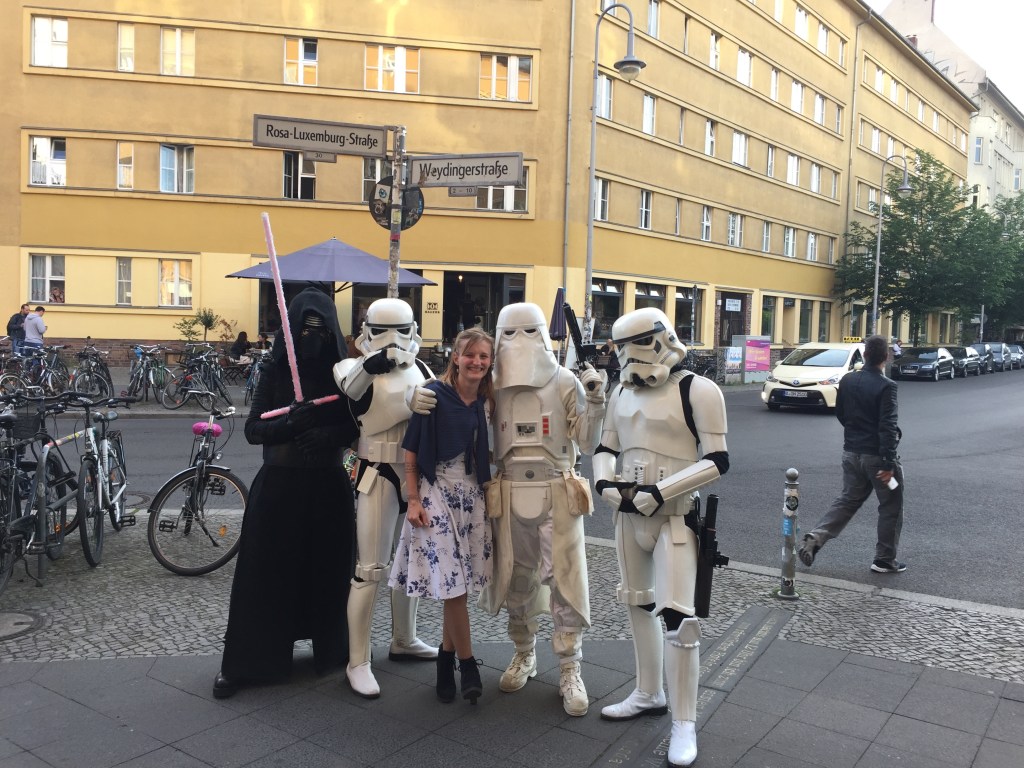
https://en.wikipedia.org/wiki/Women_in_Germany
https://www.deutschland.de/en/topic/politics/germany-basic-law-women-and-equality
https://en.wikipedia.org/wiki/Women_in_Germany
( 𝒯𝒽𝑒𝓈𝑒 𝓈𝑜𝓊𝓇𝒸𝑒𝓈 𝓅𝓇𝑜𝓋𝒾𝒹𝑒 𝒶 𝒸𝑜𝓂𝓅𝒶𝓇𝒶𝓉𝒾𝓋𝑒 𝓅𝑒𝓇𝓈𝓅𝑒𝒸𝓉𝒾𝓋𝑒 𝑜𝓃 𝓉𝒽𝑒 𝒽𝒾𝓈𝓉𝑜𝓇𝒾𝒸𝒶𝓁 𝓅𝓇𝑜𝑔𝓇𝑒𝓈𝓈𝒾𝑜𝓃 𝑜𝒻 𝓌𝑜𝓂𝑒𝓃’𝓈 𝓇𝒾𝑔𝒽𝓉𝓈 𝒾𝓃 𝒫𝑜𝓁𝒶𝓃𝒹 𝒶𝓃𝒹 𝒢𝑒𝓇𝓂𝒶𝓃𝓎, 𝒽𝒾𝑔𝒽𝓁𝒾𝑔𝒽𝓉𝒾𝓃𝑔 𝓉𝒽𝑒 𝒹𝒾𝒻𝒻𝑒𝓇𝑒𝓃𝒸𝑒𝓈 𝒾𝓃 𝓉𝒽𝑒 𝓉𝒾𝓂𝒾𝓃𝑔 𝒶𝓃𝒹 𝓃𝒶𝓉𝓊𝓇𝑒 𝑜𝒻 𝓁𝑒𝑔𝒶𝓁 𝓇𝑒𝒻𝑜𝓇𝓂𝓈 𝒾𝓃 𝒷𝑜𝓉𝒽 𝒸𝑜𝓊𝓃𝓉𝓇𝒾𝑒𝓈.)
And that’s the funny part, isn’t it? When I look at Polish women, I see this strange paradox — they got the right to vote back in 1918, way before many of their Western sisters even dared to imagine it. My great-grandmother could cast her ballot while her German counterpart was still busy asking her husband if she could buy a new pan. Poland may have been poor, tired, scarred, but the women? Oh, they were fierce. They ran the house, the kids, the garden, the church group, and half the village’s gossip network — all while looking like they just walked out of a 1930s film set. Meanwhile, in Germany, the post-war years made femininity feel almost… dangerous. Women had rebuilt cities, buried husbands, carried bricks, birthed the new republic — and then were told to smile, put on lipstick, and be quiet. “Equal rights” came later, sure, but freedom? That was rationed. Even in the 1960s, some still needed their husband’s signature to open a bloody bank account. Imagine that. You can give birth alone, you can clean up the rubble, but you can’t have a damn debit card.
And Russia — well, Russia had its own theatre. Women there could drive tractors, shoot rifles, and quote Lenin, but heaven forbid they skip the borscht. Soviet equality came with a side of exhaustion. They were equal, yes, but mostly in how equally overworked everyone was. So when people talk about “feminine energy,” I always laugh. In Poland, it’s your perfume before church. In Germany, it’s your quiet strength at the office. In Russia, it’s your red lipstick in minus twenty degrees. Same word, different battlefield.
And I can’t help thinking: maybe that’s why so many women in Germany hesitate to be overtly feminine. They remember — maybe not consciously, but somewhere deep in the bones — that softness once came with a price tag. And Polish women? They learned to weaponize charm ages ago. We can smile sweetly and still throw verbal knives across the table if needed.
That’s the real difference. Femininity, across cultures, is not just a style. It’s a survival strategy — each nation wrote its own manual.
So after all this, when I looked at the man lying on the other side of my bed, I finally understood something terrifyingly simple:
there’s nothing men fear more than the idea of not being needed.
The idea that someone might want them, but not need them — that’s the apocalypse.
Because for decades, for generations, they’ve been told the same bedtime story:
“You are the man. You are the provider. You are the saviour.”
So when a woman says, “I don’t need you — I choose you,”
it shatters something deep.
Because that means he must do the one thing his father, his school, his army never taught him to do
to work on himself. To feel. To be emotionally available. And here’s the brutal truth:
men don’t want to be emotionally available.
Men don’t want change.
They would rather go to war than go to therapy.
They would rather spend years behind bars for a femicide
than spend a single hour facing their own trauma.
And the young ones, the ones who shout loudest about “change”?
Darling, the only change they truly want
is a younger girlfriend, a newer car, a shinier apartment.
They scream that “women are stealing our jobs.”
We don’t want your jobs — keep them.
They panic that “women will dominate the world.”
Really?
You said the same about the Jews once and we all know how that ended. What women want is simple:
equal treatment, equal pay, and men who are emotionally available. Men who accept us as human beings not as objects to be rescued, polished, displayed.
We’re not diamonds in a museum that need saving. And even if we were,
did you see what happened in Paris? Not even the Louvre can keep its treasures safe forever.
So let’s stop pretending. We don’t want your wars. We don’t even want your money — not really.
Some women, like me right now, might choose to stay home for a while, to learn, to rebuild, to shift direction. And if a man can support that — wonderful. But he doesn’t need to anymore.
So dear men, if you’re reading this — listen carefully. We’re not your enemies.
We don’t want to take what’s yours. We just want to stand beside you — as equals.
We want to feel, to be seen, to be heard, to be loved without having to mother you, heal you, or babysit your broken inner child.
𝐖𝐞 𝐚𝐫𝐞 𝐧𝐨𝐭 𝐦𝐚𝐜𝐡𝐢𝐧𝐞𝐬.
𝐖𝐞 𝐀𝐫𝐞 𝐍𝐨𝐭 𝐓𝐨𝐲𝐬.
𝐖𝐞’𝐫𝐞 𝐧𝐨𝐭 𝐡𝐞𝐫𝐞 𝐭𝐨 𝐛𝐞 𝐩𝐫𝐨𝐭𝐞𝐜𝐭𝐞𝐝.
𝐖𝐨𝐦𝐞𝐧 𝐚𝐫𝐞 𝐟𝐮𝐥𝐥𝐲 𝐡𝐮𝐦𝐚𝐧, 𝐭𝐨𝐨.
Vintage Feministisch, Von eine Frau für Frauen, weibliche Gesundheit, die Zukunft ist weiblich, women health, mental health, self growing, Woman life style, feminin, koscher , halal

Hinterlasse einen Kommentar