
For a long time — let’s say five or six years ago — when I was still delightfully young but not quite as naïve, my hormones were campaigning aggressively for a baby.
My initial thought?
Well, I don’t trust men. So perhaps I’d be better off as a single mum, because my personal encounters with this particular subtype of human were… less than encouraging. But then my brain started braining. And suddenly there were too many uncomfortable questions piling up:
What if I had a daughter?
How do you tell a young girl, “Darling, that dress is too short; you can’t go outside like that without leggings,” because we live in a world where grown men apparently need legal reminders not to sexualise children?
How do you explain that she’ll be treated differently her entire life?
That she’ll be catcalled.
That she might be underpaid for overperforming compared to her male friend.
That she’ll have to navigate dangers she never asked for.
It was enough to drive me mad.
Then my friend Aisha asked, “But what if you have a boy instead?”
And I swear, I reacted like someone had just announced I’d die tomorrow:
May God have mercy on me — perhaps not much, but hopefully enough. Because raising a boy comes with an entirely different set of battles.
How do you teach him that he cannot mistreat girls? That seven is not an appropriate age to “have fun with” a girl.
That he cannot “marry” her.
That he must grow into a man who provides, protects, contributes —
and offers his partner real choice without resentment. Stay-at-home mum? Working mother? He must support either path. Which means: financial stability, emotional maturity, actual responsibility. And ideally? Build a home. Build a business. Then build a family. That’s a tall order. So I chose to have a dog instead. And, surprisingly, my hormones stabilised. Yes — I am absolutely the type of woman who calls her dog her child. In Polish we even have the perfect word for it: Psiecko — a brilliant hybrid of “dog” and “child.” No other language has captured that concept so perfectly. I cook for my dog, of course. First, because she refuses to eat most dog food. Second, because after reading a few ingredient lists I realised the real horror story wasn’t men — it was kibble. Even the premium brands felt like Russian roulette.
So here we are.
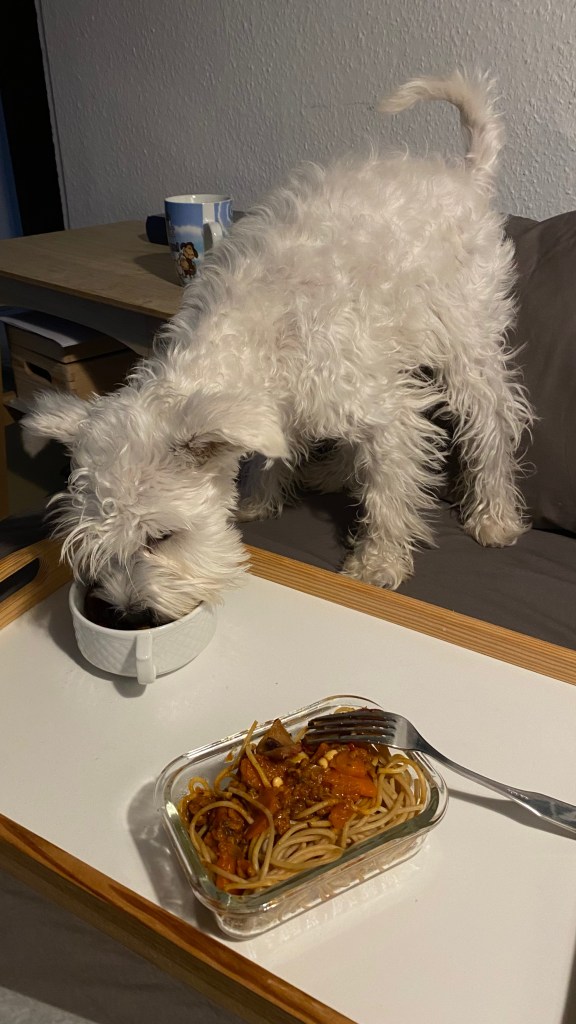
I’m still vegan–vegetarian, which made the first months… interesting.
Not killing animals personally, but buying their already-dead bodies for my dog and cooking them — that took adjustment. I tried feeding her raw, but when you travel, you simply don’t have access to consistent, safe supplies everywhere.
So cooking became the sensible compromise. And even if my dog doesn’t eat as much meat as she could, the financial impact is still very real. Just like any other child, she wants treats, of course. But not the cheap ones.
The high-quality, hypoallergenic, no-chicken-no-potato-no-periodic-table variety — the ones that remind you exactly why you hated chemistry in secondary school. I tried buying meat from Lidl and other hypermarkets, but eventually I realised that meat isn’t just meat. There’s cheap meat, questionable meat, surprisingly-watery meat, and meat that makes you question your entire life trajectory.
At some point, my financial balance was praying harder than I was.
But what wouldn’t you do to keep your child healthy, right? According to the HRS reports, a dog supposedly costs between $600 and $1,220 per year. Well… Israeli dogs must be living on the financial edge of the universe, because I have absolutely no idea how people here manage to spend so little. Either their dogs have lower expectations, or they all secretly run underground dog-food cartels. We definitely need to check the economic landscape, because something doesn’t add up. And that’s where the fun begins:
Dog ownership costs vary dramatically by country — and the numbers tell a completely different story than those polite American “$600 to $1,200” estimates.
Now, before your eyes glaze over at the thought of another polished economist’s report, let me break it down — what this fluffy little tyrant actually costs in the real world. Here is more or less the costs calculation I have for my four-legged Psiecko — and for comparison, what the economists would have you believe:
And the economists? They kindly tell you a dog costs between $600–$1,200 a year.
Reality check: if you treat your dog like a child — with fresh food, supplements, toys, grooming, medical care, and the occasional luxury item — the “average” estimate might as well be a bedtime story. Welcome to High Finance Dog Mum Edition.
But what if your economic struggle isn’t just about kibble and spa days for the dog? What if the costs escalate because of a certain narcissistic partner lurking in your past — or worse, still very much present in your current life? Suddenly, those carefully calculated budgets aren’t just numbers on a page; they become a high-stakes juggling act of vet bills, gourmet meals, and emotional inflation. Every new toy, every premium treat, every tiny indulgence for your four-legged companion feels like an exercise in strategic resource allocation — and that’s before we even get to the mental gymnastics required when your partner thinks your dog’s happiness is somehow negotiable.
The cost of a narcissistic partner, it turns out, isn’t only emotional — it can be painfully financial too. In my own case, it began innocently enough from the outside, but behind the scenes it was a subtle and relentless manipulation. My ex-partner started giving highly processed meats — salami, cured ham, other indulgent scraps — without asking me. And not in tiny amounts.
I had repeatedly explained that these treats were unhealthy, that my companion was already having some stomach issues. He would pretend to show concern, then ignore my request entirely. The issue wasn’t what he said — it was how completely he dismissed my boundaries.
What followed was predictable, yet shocking. My companion’s behaviour changed dramatically: begging at the table, jumping up, demanding the forbidden treats. A creature that had always been composed suddenly acted like a little junkie, a child deprived of their iPad. Every meal became a small battlefield.
And the fallout wasn’t just in behaviour. It came straight out of my wallet. Additional veterinary checks, supplements, vitamins, even medicated food — all of these became necessary because my instructions were ignored.
I am certainly not alone in this. Many people in narcissistic relationships find their pets weaponised as tools of control: a way to keep them tied to the household, to bend affection, to assert dominance. I happened to be lucky — my ex didn’t particularly care about animals, or perhaps he didn’t see a reason to pursue that route. But the pattern is familiar: when a partner realises that the creature you love most is a lever, it becomes part of their arsenal. Thankfully, I didn’t have to hire a full-time behaviourist — but many owners in toxic relationships do, after months or even years of subtle manipulation. Animals are, in their own right, affected by the chaos around them; just like people, they carry the emotional baggage of the environment you’ve subjected them to. A dog isn’t immune to stress, confusion, or anxiety — and when your partner is a narcissist, the fallout can be immediate and expensive.
Even after I managed to remove myself from the situation, the costs didn’t stop. It wasn’t just about getting myself to safety — finding a secure place, clothes, my own space. My companion needed a complete reset too: a new bed, fresh toys, even new bowls, because everything the previous partner had retained was part of a calculated plan to make me think twice about leaving. By holding onto our things, he hoped I’d come back, perhaps tempted to reclaim what was “mine.”
But animals, like humans, don’t understand manipulation — they just respond. And so the investment in their recovery becomes another layer of expense. Supplements, safe foods, calming toys, new sleeping arrangements. Each item a tiny reclamation of security, autonomy, and trust. Each pound spent a reminder that escaping a narcissistic environment is never just emotional — it’s financial, practical, and painstakingly granular. A narcissistic relationship, or any entanglement with a toxic partner, costs far more than just your own money and sanity. Every ounce of stress you carry — your companion feels it too. Your dog, like every living being, absorbs the tension, the chaos, the leftovers of manipulation. This is something we often forget. Dogs are sentient. They are not mere ornaments. They live, breathe, feel, and yes — they cost money, time, and energy. December is coming. And like every year, countless people will be tempted to buy a dog as a “perfect Christmas gift” — for the child, for the ‘Gram, for the illusion of joy. But think. Every burden you carry, every toxic dynamic you tolerate, your dog carries alongside you. Dogs mean commitment. Dogs mean work. Dogs mean a loss of freedom. And yet, I would never, ever trade my baby-dog for the world. Never. But the truth must be said: the cost of a living organism — a sentient life — can be enormous. I’m not talking about doggy bills alone. I’m not even talking about behavioural therapy after toxic relationships. Because you do not enter these situations alone — you bring your dog with you. And sometimes, that can be dangerous. Not because the dog bites, but because a narcissist can weaponise the animal against you, keeping it as leverage to trap you. Dogs are not gifts. Dogs are not cheap. They are living beings, and they deserve respect, foresight, and care. Treating your dog like a child, as I do, is my choice. It is not a blueprint. But never forget: a dog is life. And life is not something to be taken lightly. And let’s be clear: a dog is not just a cute accessory. A dog is a living being, a companion with needs, feelings, and a life to be respected. They require walks — sometimes three, even four times a day. They need medical care, attention, love, and emotional presence. Even on days when I feel I am falling short, I try my absolute best. I am not perfect — none of us are. We will never be. But what matters is the effort, the commitment, the choice to give our very best. That is what being a dog parent truly means.
https://www.quora.com/Does-a-narcissist-use-pets-as-a-way-of-getting-to-their-animal-loving-partner

Hinterlasse einen Kommentar